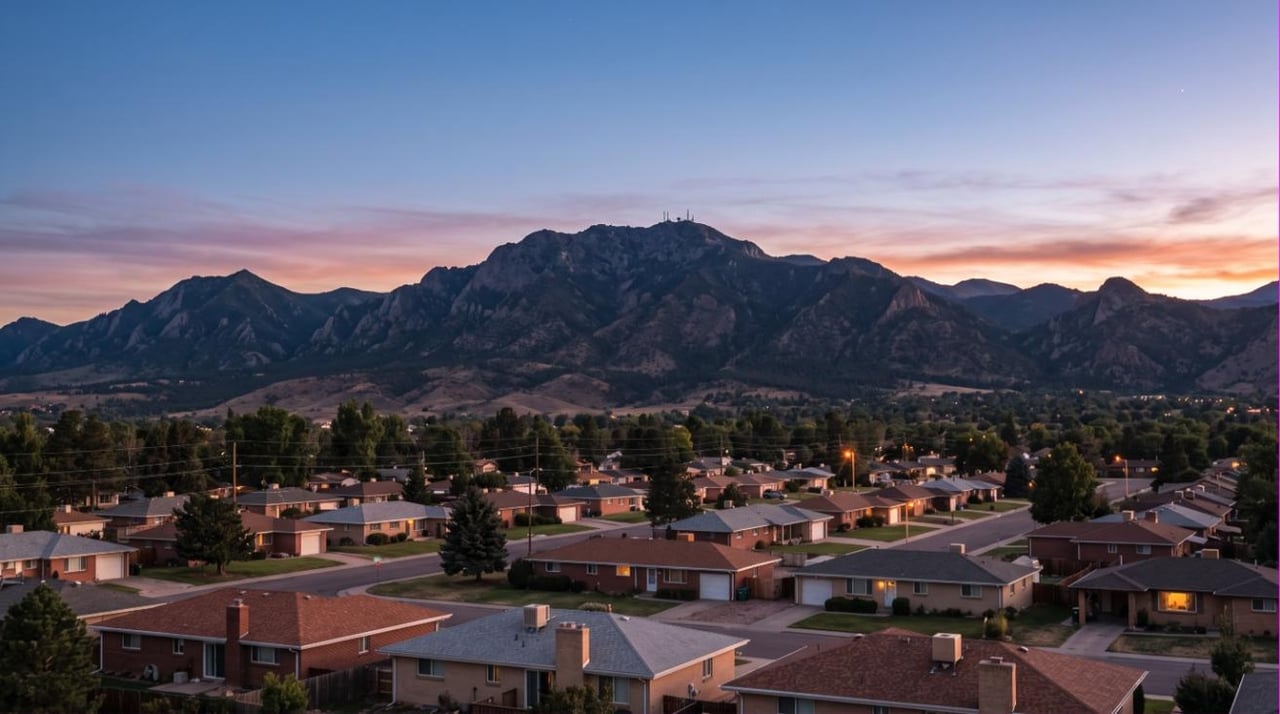
In a Stratton Meadows kitchen in April, the glass in the back door buzzed twice. Four seconds apart. The seller did not look up.
I'm Leah Behr, a REALTOR® with the Behr & Behr Team in Colorado Springs, and here is the honest map. Fort Carson noise hits the south end hardest, the airport line runs north and south through the east side, the Academy hum sits on the far north, and much of the city hears essentially nothing. Almost nobody reads the documents that say so.
Fort Carson is the loud one, and the fence does not hold the sound
Fort Carson's February 2025 fact card lists 236,000 acres, 85 ranges and 37 mortar firing points. The Army's 2014 environmental assessment for the 4th Infantry Division brigade conversion names the source plainly: "firing of weapons, specifically large-caliber weapons such as artillery and tank main guns."
It also maps where the sound lands. The Land Use Planning Zone, an intermediate band below the formal noise zones, "extends beyond the eastern boundary of Fort Carson, past Interstate-25 encompassing El Rancho, Midway Ranches, and the City of Fountain." Noise Zone II reaches El Rancho, Midway Ranches and Turkey Canyon Ranch. Zone III, the most restrictive band, touches undeveloped parts of Fountain, El Rancho and Turkey Canyon Creek.
The mapped zones sit south and east of the post, so Security-Widefield and built-up Fountain fall largely outside them. Broadmoor Bluffs, Cheyenne Mountain and Stratton Meadows sit north of the boundary, outside any mapped zone I found, and still catch the concussion. A pressure wave does not check a contour line.
Jason Atkinson, then battalion commander of the 2nd Battalion, 12th Field Artillery Regiment, told KOAA on August 6, 2019: "We truly wouldn't do it if we didn't feel like it was necessary for us to be successful in combat." I believe him. It does not make the windows quieter.
DNL 65 is an average, and that is the part the brochures skip
Every noise map here runs on one metric. The FAA states it on its community response page: "FAA has adopted DNL 65 dBA as the threshold of significant noise exposure, below which residential land uses are compatible." HUD draws the same line: under 24 CFR 51.103(c), above 65 dB is "normally unacceptable" and above 75 dB is "unacceptable." The Army uses parallel bands, aviation Zone II at 65 to 75 ADNL and large-arms Zone II at 62 to 70 CDNL.
Here is what the number hides. DNL averages 24 hours across an average day of the year, with a 10 decibel penalty on events between 10 p.m. and 7 a.m. Average a battery firing for two hours across the other 22 quiet hours, then across 365 days, and a startling address lands under 65. The FAA's own research supports the skepticism. When it released the Neighborhood Environmental Survey on January 13, 2021, the aviation firm Kaplan Kirsch reported that at DNL 65, between 60.1% and 70.9% of people were highly annoyed, against roughly 12.3% under the older curve. Do not read "outside the contour" as quiet. Read it as federal indifference.
Butts, and the rotors over the southwest
Butts Army Airfield became Butts Army Heliport in 2022, per Fort Carson's Directorate of Plans, Training, Mobilization and Security. Its 4,500-foot runway, finished in 2016, serves helicopters and drones, and the 4th Combat Aviation Brigade flies from it. Rotor noise is lower and longer than artillery, and it travels. The 2014 assessment describes a "Fly Neighborly" policy meant to reduce it. I found no published route map, so I will not draw one. If Broadmoor Bluffs or Cheyenne Mountain is on your list partly for quiet, go twice, at different hours.
One set of runways serves the airport and Peterson
Peterson Space Force Base and Colorado Springs Airport share an airfield. Per AirNav's published FAA data, two of its three runways run nearly due north and south, 17L/35R at 13,500 feet and 17R/35L at 11,022 feet, with 13/31 cutting diagonally at 8,270 feet. The Air Force Reserve's 302nd Airlift Wing flies C-130 Hercules aircraft from Peterson, and per its March 2025 fact sheet it is the only Reserve wing equipped for aerial firefighting.
Geometry tells you where traffic goes. That north-south alignment puts arrivals and departures over the Powers corridor, Springs Ranch and Claremont Ranch to the north, and over Security-Widefield and Fountain to the south. Headings are not a measured contour, though, and none exists. Colorado Springs Municipal Airport is absent from the FAA's list of airports with Part 150 Noise Exposure Maps, which for Colorado shows only Centennial, dated August 1, 2017, and a Denver International study. Buying in the Powers and Stetson Hills area and want a federal noise map for your street? There is not one.
Colorado's disclosure form is silent, and the city's zoning code is not
I read the Colorado Division of Real Estate's Seller's Property Disclosure (Residential), form SPD19, the version for use on or after January 1, 2026. Section N, Environmental Conditions, runs seventeen line items, from hazardous materials to mine shafts and odors. None mentions noise, aircraft, an airport, or a military installation. Colorado does not require a seller to disclose that a house sits under a departure path.
The city code is a different story. Colorado Springs City Code section 7.2.601 establishes the AP-O Airport Overlay. Inside the ADNL subzone, described in the code as "the sixty-five (65) DNL airport noise zone," residential development must achieve "a noise level reduction of thirty (30) dBA." Inside the ANAV subzone an avigation easement "must be granted and recorded" as a condition of approval, and the plat must reference the recording information. The disclosure exists. It just sits on the plat, not the seller's form.
The Academy end, and the one week the whole north side hears it
The Air Force Academy runs what Air Education and Training Command calls "the largest and most active soaring operation in the U.S.," with the 94th Flying Training Squadron flying more than 30,000 sorties a year. Gliders are silent. Tow planes are not, and neither are the UV-18B Twin Otters carrying the roughly 500 cadets a year who earn parachutist badges. Its flight operations page says flying over Larkspur was eliminated because of complaints.
Graduation is the outlier. In 2026 it fell on Thursday, May 28, with Thunderbirds practice over Falcon Stadium the day before, roughly 10 a.m. to 4:30 p.m. The team flew the flyover and the air show was canceled, per KKTV. Northgate, Gleneagle and Pine Creek sit closest. Most weekdays this is light-aircraft hum, so if you are weighing the Northgate side of town, plan for a handful of loud days, not a constant.
Where I could find no noise at all, Schriever included
Schriever Space Force Base sits about 10 miles east of Peterson and runs command and control for more than 170 Department of Defense satellites, including the main GPS control point in Building 400. Nothing in its public description involves a runway or flight operations, and I found no noise contour, noise office or complaint program there. If a listing near Falcon or Ellicott hints at Schriever noise, I can find no support for that.
Large parts of the county hear little of this. The near-westside, Old Colorado City, Rockrimmon, Patty Jewett, the Old North End and Black Forest sit far from the ranges and off the runway alignment. Not silent, just a different subject, which I take up in how I help buyers pick an area.
Nobody has measured the price effect in El Paso County
I looked for peer-reviewed or agency work on military noise and home values in El Paso County. I found none specific to this county, this post, or this airport. What exists is national. Jon P. Nelson's meta-analysis in the Journal of Transport Economics and Policy, volume 38, January 2004, pooling 20 studies across 23 US and Canadian airports, reported that "the cumulative noise discount in the U.S. is about 0.5% to 0.6% per decibel at noise exposure levels of 75 dB or less." Melissa R. Johnson's 2006 Air Force Institute of Technology thesis found a significant negative price effect inside the 65 dB DNL contour of Air Force installations. Neither is Fountain. If somebody quotes a discount percentage for a street here, ask to see the study.
Testing a specific address before you write an offer
All free.
- Fort Carson Public Affairs, 719-526-9849, weekdays 7:30 a.m. to 4:30 p.m., or [email protected]. After hours the Emergency Operations Center at 719-526-3400 or 719-526-5500 reaches an on-call officer. Ask what is scheduled, and read the advisories at home.army.mil/carson. One warned through KRDO on April 22, 2026, of noise and dust from a month-long exercise starting May 1.
- The Academy's noise and overflight complaint form, to [email protected], or Public Affairs at 719-333-7746.
- City of Colorado Springs zoning. Ask the planning counter whether the parcel is in the AP-O overlay and which subzone, citing code section 7.2.601. ADNL means the 65 DNL band. ANAV means a recorded avigation easement.
- El Paso County Clerk and Recorder, publicrecordsearch.elpasoco.com. Search for a recorded avigation easement, confirm it on Schedule B-2 of your title commitment, and read the plat notes.
- The Colorado Springs Regional Joint Land Use Study, from the Pikes Peak Area Council of Governments, completed December 2018, covering five installations, at ppacg.org. Limit: the file was too large for me to open, so I am pointing rather than summarizing.
- The Bureau of Transportation Statistics National Transportation Noise Map. BTS says it is "intended for the tracking of trends and should not be used to evaluate noise levels in individual locations," excludes helicopters, and ignores terrain.
- The FAA Noise Portal at faa.gov/noise will not help with the military sources above. The agency says so: "The FAA does not release information regarding the operations of military aircraft."
- Go stand there. A weekday evening and a Saturday morning, thirty minutes each. Fort Carson advisories say noise runs through the day "and into evening hours," so ten o'clock on a Tuesday tells you almost nothing.
The gaps in this I could not close
Fort Carson has no AICUZ study, and a blog that says otherwise is confusing the services. Per the Department of Defense DENIX noise pages, AICUZ is an Air Force program; the Army uses Installation Compatible Use Zone work and operational noise management plans. Fort Carson's Environmental Noise Management Plan was described as updated in 2006 in the Army's 2014 assessment, and I could not find a current contour map for the post, a posted AICUZ for Peterson, or a working link to the airport's noise page. Those are gaps in the record, not evidence of quiet.
Sorting a shortlist by sound, the way I would
Ask what kind of noise you actually mind first, because artillery and airliners are not the same problem. Pull the plat and title commitment early, not at the deadline, and look for an avigation easement. Call 719-526-9849 while you are under contract. Visit twice, once after dark. Then say the disappointing part out loud. If your budget points you at Fountain or the south end, you are trading quiet for price, and no inspection objection fixes that. The trade is fine when you make it on purpose.
I'm Leah Behr, and I have shown houses within earshot of all of these installations. Some buyers stop noticing in a month. Others still notice years later. I would rather you find out on a Tuesday evening in April than in September, after closing.
Equal Housing Opportunity. I am a REALTOR®, not an acoustician, engineer, lawyer or appraiser, and nothing here is legal, engineering or valuation advice. Training schedules, flight operations, zoning overlays and disclosure rules change, so verify what matters with Fort Carson Public Affairs, Air Force Academy Public Affairs, Colorado Springs Planning, the El Paso County Clerk and Recorder, the Colorado Division of Real Estate and the FAA. I do not steer buyers toward or away from any area, and every buyer is welcome in every neighborhood described here.