The floor is 96 decibels. The ceiling is 110, measured 100 feet in front of the locomotive, and both numbers are federal law.
I'm Leah Behr, a REALTOR® with the Behr & Behr Team in Colorado Springs, and here is the part buyers want first: eight public crossings in El Paso County carry a 24-hour whistle ban, all of them in Fountain, Security or Monument. Everywhere else along these tracks the horn is mandatory, and nobody is coming to fix that for you.
What the horn is legally required to do
49 CFR 229.129 sets the sound. It requires "a minimum sound level of 96 dB(A) and a maximum sound level of 110 dB(A) at 100 feet forward of the locomotive in its direction of travel." That is a floor, not just a cap.
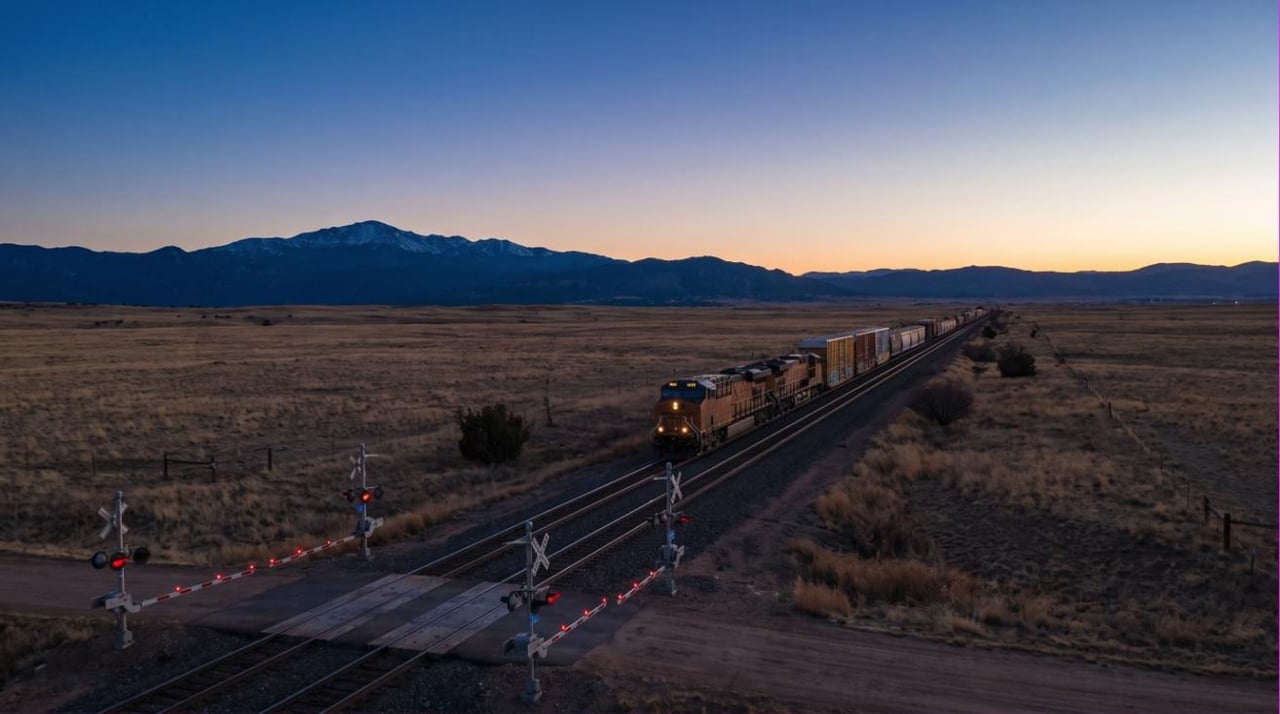
49 CFR 222.21 sets the rest. Two long blasts, one short, one long, repeated until the locomotive occupies the crossing, beginning at least 15 seconds and no more than 20 seconds before the train enters. Above 60 mph it cannot start more than a quarter mile, or 1,320 feet, ahead. There is no nighttime exemption anywhere in the rule.
Sound falls off with distance. Using the inverse-square rule, roughly 6 decibels per doubling, a 96 to 110 dB(A) horn at 100 feet lands near 78 to 92 dB(A) at 800 feet. That is my arithmetic on the FRA's regulated range, and it ignores terrain, walls and wind. So the thing to locate is not the track. It is the nearest public at-grade crossing, because the crossing triggers the horn.
Where the rails actually run through this county
The corridor is the Joint Line, and it is shared. In the FRA's National Highway-Rail Crossing Inventory, the current file on data.transportation.gov with El Paso County records revised as recently as June 25, 2026, Union Pacific reports its crossings under the Colorado Springs Subdivision and BNSF reports its own under the Pikes Peak Subdivision. On several Fountain streets both railroads file a separate record for the same road, which is what two parallel mainlines look like in data.
The line enters at Palmer Lake, runs through Monument, passes the Air Force Academy west of I-25 below Gleneagle, drops down the west edge of Colorado Springs past downtown and Ivywild, then continues through Stratmoor, Security-Widefield and Fountain toward Pueblo. The rest is small: four private crossings on Rock & Rail's Drennan trackage, seven Department of Defense crossings, and one private Cog Railway crossing the horn rule does not reach.
Segment and reporting railroad | Day + night through trains | Max timetable speed |
|---|---|---|
Palmer Lake, Monument, Air Force Academy (UP) | 9 + 8 = 17 | 30 to 45 mph |
West and south edge of downtown (UP) | 11 + 11 = 22 | 30 to 40 mph |
Security and Fountain (UP) | 14 + 14 = 28 | 50 mph |
Security and Fountain (BNSF) | 9 to 18 | 50 to 55 mph |
Those are per-record counts. Where both railroads cross the same street, a house nearby hears both, so add them.
The eight crossings with a whistle ban on file
I pulled all 35 open public at-grade crossings in the county out of that inventory and sorted by the whistle ban field.
Crossing | Railroad | Ban date on file |
|---|---|---|
Fontaine Blvd | BNSF | Sept 4, 2008 |
Main St, Security | BNSF | Sept 4, 2008 |
2nd Street, Monument | Union Pacific | Aug 29, 2009 |
Comanche Village Drive | UP and BNSF | April 12, 2019 |
Ohio Avenue, Fountain | Union Pacific | April 12, 2019 |
Link Road, Fountain | Union Pacific | April 12, 2019 |
Duckwood Road | BNSF | Sept 26, 2019 |
Two things surprised me. Monument's one public at-grade crossing has a ban and Palmer Lake's two do not, so Palmer Lake hears 17 trains a day announce themselves at County Line Road and East Noe Road. At Ohio Avenue the Union Pacific record shows a ban and the BNSF record for the same street shows none. Stand at the crossing before you believe either one.
Why Colorado Springs proper has no ban anywhere
Because it mostly does not need one. The inventory shows 15 open public at-grade crossings inside Colorado Springs against 30 grade separations, 11 where the railroad goes over and 19 where it goes under, and most of the at-grade ones are industrial spurs and military trackage posted at 5 or 10 mph with no reported through trains.
The exceptions are three crossings west and south of the core, at South Sierra Madre Street, West Las Animas Street and South Royer Street, each reporting 22 through trains a day. If you are shopping downtown condos, Ivywild bungalows or the near-north side, those three decide whether you hear a four-blast pattern at 2 a.m.
What making a quiet zone actually takes
Not you, and not your HOA. Under 49 CFR Part 222 a quiet zone is established by the public authority with jurisdiction over the crossings, which the FRA defines as "the entity responsible for traffic control or law enforcement at the public crossings (such as a city or county)."
A new zone must run at least one-half mile under 222.35, and every public crossing in it needs flashing lights and gates. The authority then either installs a Supplementary Safety Measure at each crossing or proves under 222.39 that the Quiet Zone Risk Index sits at or below the Nationwide Significant Risk Threshold or the Risk Index With Horns. Appendix A lists what qualifies: four-quadrant gates, gates with medians or channelization devices reaching at least 100 feet from the gate arm, a one-way street with gates, or closing the crossing. Notice of Intent goes out 60 days ahead, and compliance is reaffirmed periodically after that.
Colorado adds a step national articles skip. The Colorado Public Utilities Commission states on its Rail and Transit page that it "has primary jurisdiction over all public highway-rail crossings, including opening, closing, upgrading, signalizing, construction of overpasses or underpasses, and the allocation of costs." Gates and medians are crossing modifications, so the PUC is in that conversation.
A quiet zone can also be taken away. In a notice published November 24, 2025, John Karl Alexy, the FRA's Associate Administrator for Railroad Safety and Chief Safety Officer, opened a review of a Miami quiet zone whose risk index had climbed above the Risk Index With Horns, writing that "the Associate Administrator may require that additional safety measures be taken or that the quiet zone be terminated." Buy assuming the horn could return.
Wayside horns, and the one I could not find
A wayside horn sits at the crossing and points down the road instead of broadcasting from a moving train. Appendix E to Part 222 requires 92 to 110 dB(A) measured 100 feet from the centerline of the nearest track, aimed at approaching traffic. Because it faces drivers rather than sweeping a quarter-mile arc of houses, the neighborhood hears far less of it, and 222.59 treats it as equivalent to a Supplementary Safety Measure. I found no record of one in El Paso County.
Vibration is a separate problem with no rule behind it
The horn rule says nothing about the shudder in a basement wall. The federal reference is the FTA's Transit Noise and Vibration Impact Assessment Manual, Report No. 0123, September 2018, which sets indoor ground-borne vibration criteria for residences at 72 VdB for frequent events, 75 for occasional and 80 for infrequent. Those criteria govern new transit projects. They oblige nobody to fix an existing house beside an existing railroad. A general inspector will not measure VdB, so hire an acoustical consultant before your inspection deadline if it matters to you.
SPD19 has no line for train noise
The Colorado Real Estate Commission's Seller's Property Disclosure (Residential), form SPD19, in the version approved for use on or after January 1, 2026, covers radon, drainage, metropolitan districts and environmental conditions. It has no noise item, no railroad item and no airport item, and it limits itself to what is "correct to Seller's CURRENT ACTUAL KNOWLEDGE." A seller who has heard 28 trains a day for nine years does not have to write it down.
Two free federal databases, searched by address
- FRA Rail Crossing Locator, at fra.dot.gov/railcrossinglocator. The FRA page for it, last updated December 10, 2025, says you can "locate crossings by U.S. DOT Crossing ID number, address, or geo-location." Type the address, find every crossing within a mile, and read the whistle ban field, the day and night train counts, the timetable speed and the warning devices.
- FRA Office of Safety Analysis, at safetydata.fra.dot.gov. Query by crossing number for the inventory record and the accident history at that crossing. The site states its accident data runs through May 31, 2026.
Both are self-reported by railroads and state agencies, and as Ohio Avenue shows, two records for one street can contradict each other. Neither covers switching moves or idling locomotives. Build a shortlist, then go stand there at 10 p.m. on a weekday.
What this county's own accident records show
FRA Form 54 lists six reportable rail equipment events in El Paso County from 2019 through 2024: derailments at Palmer Lake in September 2024, in Colorado Springs in October 2023 and October 2022, at Monument in May 2020, and in Colorado Springs in August 2019, that last one at 22 mph with $2,045,296 in damage. Every one reported zero cars carrying hazardous material and zero injuries. Form 57 shows seven crossing incidents here from 2016 through 2025, with one death, in 2025. That is a real risk and it is not a large one.
Passenger rail would add trains, not remove horns
The Front Range Passenger Rail District published a draft delivery plan for the service it now calls the Colorado Connector, dated July 17, 2026. It describes starter service north of Denver around 2029, then a Phase 2 extension reaching Colorado Springs and Pueblo around 2032, paid for by a proposed 0.333% sales and use tax that could reach voters as soon as November 2026, with a station here at milepost 75.1 and two round trips a day. None of that is decided. But passenger trains would use this same Joint Line and sound the same horn at the same crossings.
Three rail figures nobody publishes for this county
Cost, first. I could not find an FRA-published dollar figure for a quiet zone or a wayside horn per crossing, and I will not repeat a number off a vendor page. The shape of it is engineering, gates, medians, PUC involvement, notices and a recurring reaffirmation duty. That is a capital project a municipality budgets for, not a form a neighborhood files.
Second, the legal status of those eight bans. The FRA's public quiet zone report pages returned internal server errors when I tried them on August 5, 2026, so I could not confirm which are formally established Part 222 quiet zones rather than older bans carried forward in the inventory.
Third, price effect. I found no study measuring what rail proximity does to home values in El Paso County. Not one. Findings from other markets exist and I am deliberately not importing them, because this county's grade separations, terrain and train counts are not those markets. If someone quotes you a discount for backing to the tracks, ask which El Paso County sales it came from.
How I would shop a house near the Joint Line
Start with the crossing, not the track. Run the address in the Rail Crossing Locator, list every public at-grade crossing within about a mile, and write down the whistle ban field and the train count for each. If any shows no ban, assume horns, day and night.
Then go listen twice, once around 10 p.m. and once before 6 a.m., because half of Fountain's 28 daily trains are reported as nighttime moves. The honest test is whether the second visit changes your mind. For the wider daily texture here, see what it is really like to live in Colorado Springs.
Then price it in. A house near an unbanned crossing is not a defective house. It has a known, permanent condition that some buyers stop hearing and others cannot tolerate. What I will not do is tell a buyer a quiet zone is coming. As of August 2026 I could find no municipality here that has published a plan for one.
I have walked buyers up to crossings in Fountain and Security after dark more than once, and the reaction splits about evenly. Half stop noticing inside a month. The other half know within ninety seconds. There is a wrong time to find out, and it is after closing. Leah Behr, Behr & Behr Team, The Platinum Group, Realtors, Colorado Springs.
I am a REALTOR®, not an acoustical engineer, an attorney or a railroad official, and nothing here is legal or engineering advice. Verify crossing data with the Federal Railroad Administration, quiet zone status with the municipality or county that has jurisdiction over the crossings, and Colorado crossing approvals with the Colorado Public Utilities Commission. Records change. The Behr & Behr Team supports Equal Housing Opportunity and does not steer buyers toward or away from any area.