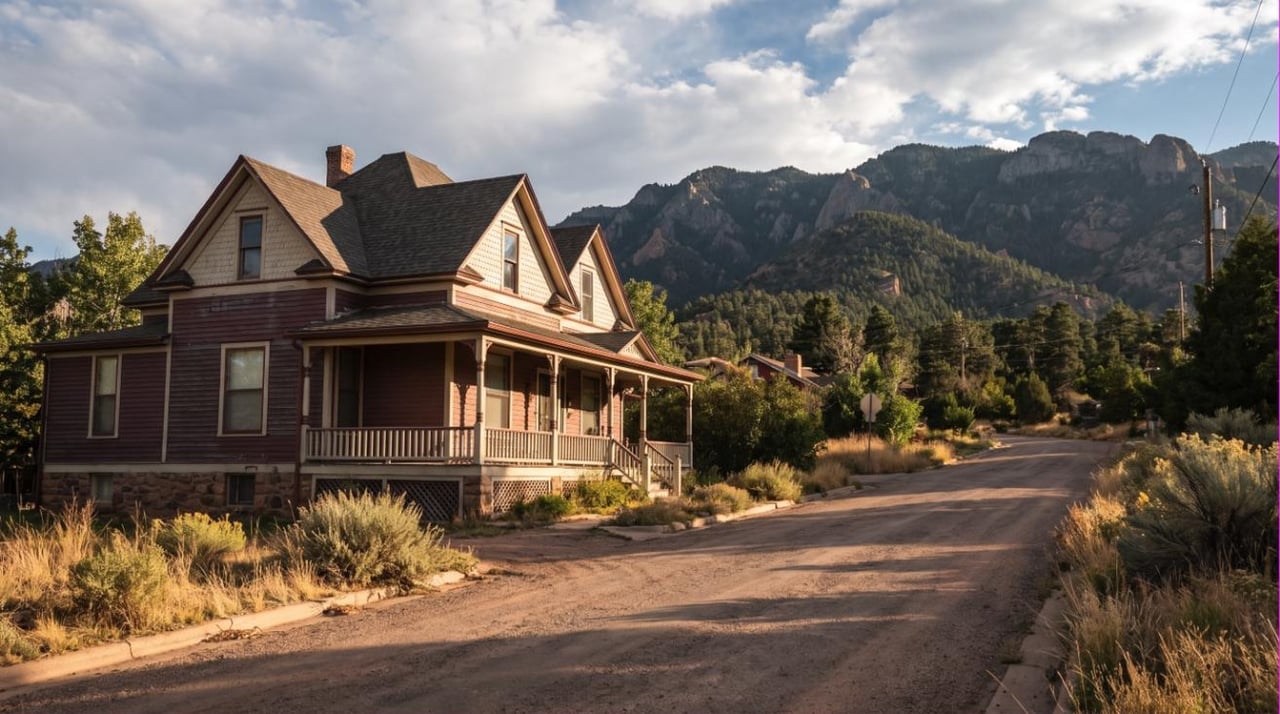
A 304 square foot addition on Wood Avenue needed a public hearing. City file HIST-26-0005, introduced May 18, 2026, went to the Historic Preservation Board on June 1.
I'm Leah Behr, a REALTOR® with the Behr & Behr Team in Colorado Springs. A local historic overlay means design review on exterior permit work that shows from the street. A National Register listing, by itself, restricts almost nothing you do with your own money. Buyers treat those two as one thing, and they are not.
That file also proposed converting a detached garage into a 1,248 square foot accessory dwelling unit. The city record lists the zoning as R-1 9 HP-O, Single-Family Large with a Historic Preservation Overlay, presented by Urban Planner II Ethan Shafer. Two weeks from intake to hearing.
National Register listing and a local overlay are two different animals
The National Park Service says it about as plainly as an agency can, in its National Register frequently asked questions, retrieved August 2026: "Under Federal Law, the listing of a property in the National Register places no restrictions on what a non-federal owner may do with their property up to and including destruction, unless the property is involved in a project that receives Federal assistance."
History Colorado, the state preservation office, agrees: "listing offers no automatic protection. Private owners of National and State Register properties using private funds may alter or demolish these properties within existing local building regulations."
Restrictions come from the local overlay. In Colorado Springs that is the HP-O, Historic Preservation Overlay, established at section 7.2.101 of the Unified Development Code in Chapter 7 of the City Code, as published by American Legal Publishing and current through Ordinance 25-45 for that section. A new HP-O is adopted like any rezoning, under code section 7.5.704. If a listing agent tells you a house is protected because the neighborhood is on the National Register, both agencies above contradict that.
Which Colorado Springs districts carry which designation
National Register districts here include the Old North End Historic District, listed December 17, 1982, with a boundary increase September 14, 2015; the Old Colorado City Historic Commercial District, listed November 2, 1982; and the North Weber Street-Wahsatch Avenue Historic Residential District, listed February 8, 1985. Those dates come from a public index compiled from National Park Service data, because the NPS search interface would not return results to me. Confirm yours at npgallery.nps.gov.
Local HP-O coverage is much smaller. City Council adopted design standards for the overlay associated with the Old North End Historic District by resolution on February 23, 2021, file CPC ZC 20-00161. In 2025 the city added the Parkside Historic District, an HP-O over 4.15 acres west of North Cascade Avenue and east of Monument Valley Park between West Dale Street and St. Vrain Street, file ZONE-24-0018, adopted as Ordinance 25-54. The Old North End Neighborhood's own guidance says Sub-areas 1, 2 and 3 of the National Register district fall under city overlay zoning. Parts of the neighborhood, not all of it.
Old Colorado City is the counterexample. Its National Register district is commercial, from 1982, and I found no historic preservation overlay there in the city's legislative record from 2015 through July 2026. It does carry the Old Colorado City Security and Maintenance District, whose annual mill levy Council certified in August 2025 for assessments payable in 2026, file 25-443. That reaches a tax bill, not a design review, and our Old Colorado City lifestyle post does not cover it.
What sends you to the Historic Preservation Board, and what does not
The trigger, per the Old North End Neighborhood's published restoration guidance, is that "exterior improvements from the public right of way that require a Regional Building permit also require prior review and approval from the City's Historic Preservation Board." The adopted design standards agree: "The design standards apply only to work affecting the exterior of the properties that requires a permit issued by the Pikes Peak Regional Building Department."
Permit plus visibility. Both, not either.
- Paint color. Not addressed in the adopted standards at all. Nobody approves your color.
- Windows. Replacement does not require approval unless you enlarge an opening, reduce one, or add one. The standards prefer keeping originals and adding low-profile interior storms.
- Roofing. Re-roofing does get reviewed, on its own application. The standards accept metal, clay tile, wood and certain asphalt shingles, at a minimum 6:12 slope.
- Siding. No vinyl or aluminum over original wood clapboard or shingles. Unpainted brick stays unpainted.
- Additions. Rear, subordinate, rooflines echoing the original.
- Accessory structures. A shed needing no permit is exempt. A garage conversion is not.
- Interior work. Outside the standards entirely. Gut the kitchen.
One distinction before you argue with a contractor. The city publishes both guidelines and standards, and the North End guidelines say so themselves: "These guidelines are an information resource only and they have no force of law." Standards bind. Guidelines advise.
The calendar is the real cost
The board meets the first Monday of the month at 4:30 p.m. at 30 S. Nevada Avenue, Suite 102, per the city's Legistar calendar. Published 2026 dates run January 5, February 2, March 2, May 5, June 1 and August 3, so some months drop off. Six preservation cases appear on the 2026 docket through late July. Low volume, not a gauntlet.
Wood Avenue took two weeks from introduction to hearing. Miss a submittal window in a month with no meeting and you wait eight weeks instead. If your contractor has a crew booked, that gap is what hurts.
Solar, and a statute that covers less ground than people assume
Colorado does have one. C.R.S. 38-30-168 voids any covenant or restriction in a deed, contract or security instrument that effectively prohibits installing a renewable energy generation device. It permits aesthetic restrictions on dimensions, placement or appearance, so long as they do not raise cost more than ten percent, cut performance more than ten percent, or require review longer than sixty days.
Read what it governs. Private covenants. It is not written as a limit on municipal zoning authority, and I could find no Colorado statute now in effect, as of August 2026, overriding local historic design review for a solar array. The adopted North End standards say "New skylights and rooftop mechanical or service equipment, such as solar collectors or air conditioners, should not be visible from the front street." Rear roof plane, usually fine. Front roof plane on a Wood Avenue foursquare is a conversation with the board.
The state tax credit most owners here skip
Under C.R.S. 39-22-514.5, a residential preservation credit runs twenty percent of qualified rehabilitation expenditures in urban areas and thirty-five percent in rural communities, on work exceeding $5,000, against Colorado income tax. History Colorado's residential credit page, retrieved August 5, 2026, describes a two-part application, Part 1 reserved before work begins and Part 2 after completion, with a $250 Part 1 fee and a Part 2 fee scaling from nothing under $15,000 to $750 above $100,000.
Two numbers disagree and I am not picking a winner. The 2024 published statute text caps the credit at $50,000 per residential structure over a rolling ten-year period that restarts with each change in ownership, and ends the program for tax years beginning on or after January 1, 2030. History Colorado's current page says applications received on or after January 1, 2025 are capped at $100,000, and states no sunset. The statute was amended in 2024 effective January 1, 2025, which likely explains the gap. Confirm the governing number before you budget.
The eligibility chain is what almost nobody works out. The property must be at least fifty years old and on the State Register, or contributing to a certified local government district. C.R.S. 24-80.1-105(3) provides that "Property included in the national register shall be included in the state register without determination by the society, by reason of such inclusion." A contributing house in either National Register district is therefore already on the State Register, no local overlay required. Colorado Springs is not among the fifteen approved local reviewing entities, so applications go to the State Historic Preservation Office. Manitou Springs is.
One correction, because it gets repeated: the federal twenty percent rehabilitation credit does not apply to an owner-occupied house. History Colorado files it under "Federal Commercial Credit," limited to income-producing property.
Insurance, appraisal, and what is under the plaster
I am not an insurance agent and none of this is insurance advice. I found no published Colorado data measuring what historic designation does to a premium or an appraisal here, and I am not inventing one. Colorado Insurance Commissioner Michael Conway, in the Division of Insurance's February 11, 2026 report covering twenty carriers and roughly eighty percent of the market, said: "The data is clear: it is hail that is the biggest cost driver of homeowner insurance for families." Ask your agent about ordinance or law coverage, the endorsement that responds when a rebuild has to meet standards the original construction did not.
The physical issues predate the districts. Knob and tube wiring, galvanized supply lines, clay sewer laterals, single-pane sash, settlement in a grid platted before anyone wrote a soils report. Colorado Springs Utilities publishes a service line responsibility page for water and wastewater, worth reading before you assume the utility owns the pipe under your yard. Scope the sewer line. No city rule requires it, which is why buyers skip it.
The federal lead rule is not optional. Under Section 1018 of Title X, 42 U.S.C. 4852d, the seller of pre-1978 housing must disclose known lead-based paint and hazards, hand over available records and reports, provide the EPA pamphlet "Protect Your Family From Lead In Your Home," include a lead warning statement, and give the buyer ten days to conduct a paint inspection or risk assessment, which the parties may modify in writing or the buyer may waive. Here that is essentially every house. Our Old North End buying post goes deeper on condition.
Five free lookups and about twenty minutes
- El Paso County Assessor property search, property.spatialest.com/co/elpaso. Year built, ownership, sales history, assessed value. Limit: it will not show an overlay.
- The city zoning designation for the parcel. The one that matters. A local overlay appears as an HP-O suffix, the way the Wood Avenue record reads R-1 9 HP-O. No HP-O, no city design review.
- Colorado Springs Legistar, coloradosprings.legistar.com. Free, searchable, underused. Every HP-O ordinance and past board case sits in there by address, staff reports included.
- The National Register database at npgallery.nps.gov. Limit: it returns districts, not parcel-level contributing status, which lives in the nomination document and is what the tax credit turns on.
- Pikes Peak Regional Building Department permit search, pprbd.org. Free by address, and the fastest way to learn whether that finished attic was permitted.
History Colorado's Compass database is the sixth tool people name. It requires an application for login credentials, so do not count on it inside a contract deadline.
What the public record would not tell me
The application fee for a Report of Acceptability. Not published anywhere I could reach. Call planning and ask before assuming it is trivial.
A complete, dated list of every local HP-O district. The legislative record I can search runs from roughly 2015, and the Old North End overlay predates its 2021 design standards by an amount I could not pin down.
A median sale price for either district. The Pikes Peak Association of REALTORS published a July 2026 snapshot showing a $460,000 median sale price, 1,359 closed sales and 52 average days on market region-wide, and the June 2026 single-family median for El Paso County was $499,999. Neither is an Old North End number. Anybody quoting you one computed it themselves.
How I would run a designated address with a buyer
Pull the zoning string first. No HP-O, and the historic label is marketing plus a tax credit opportunity. With an HP-O, look at what the buyer actually plans. Interior remodel, paint, rear-facing solar, a shed: proceed. Front elevation change, garage conversion, second story, or a scrape: build the board calendar into the contract before you sign, and price the delay honestly.
Either way, ask whether the house is contributing to the National Register district, because that is what puts the state credit on work you were doing anyway. Our property tax post handles the tax bill itself.
I have walked buyers through both neighborhoods enough to know the worry points at the wrong thing. It is rarely the design standards. It is the eight-week gap when a meeting gets canceled and your contractor moves on. Ask me for the zoning string on any address and I will pull it before you tour it. Leah Behr, Behr & Behr Team, The Platinum Group, Realtors.
Equal Housing Opportunity. I am a REALTOR®, not a lawyer, engineer, insurance agent or tax professional, and nothing here is legal, insurance or tax advice. Verify overlay status with the City of Colorado Springs Planning Department, permit history with the Pikes Peak Regional Building Department, register status and credit eligibility with History Colorado and the National Park Service, and your tax position with a licensed professional. Code sections, credit amounts and deadlines change; this reflects sources published in August 2026.