Colorado Springs Utilities expects about 54% of normal runoff into its reservoirs this year. It has still not restricted a single watering day.
I'm Leah Behr, a REALTOR® with the Behr & Behr Team in Colorado Springs, and the 2026 rule is short: three days a week, days of your choosing, and no sprinklers between 10 a.m. and 6 p.m. from May 1 to October 15. That is it. No drought stage tightens it further right now, and no state law makes you remove a lawn you already have.
The six rules your sprinklers actually have to follow
These are a city ordinance, not a seasonal announcement. The City of Colorado Springs says Council adopted them in December 2019 and they took effect May 1, 2020. Colorado Springs Utilities publishes six:
- Water up to three days a week, and you pick the days.
- From May 1 to October 15, run sprinklers before 10 a.m. or after 6 p.m.
- No pooling on hard surfaces, no runoff down the gutter.
- Repair a leaking sprinkler system within 10 days.
- Use a shut-off nozzle when washing anything with a hose.
- Wash driveways, sidewalks and patios only for a public health or safety reason.
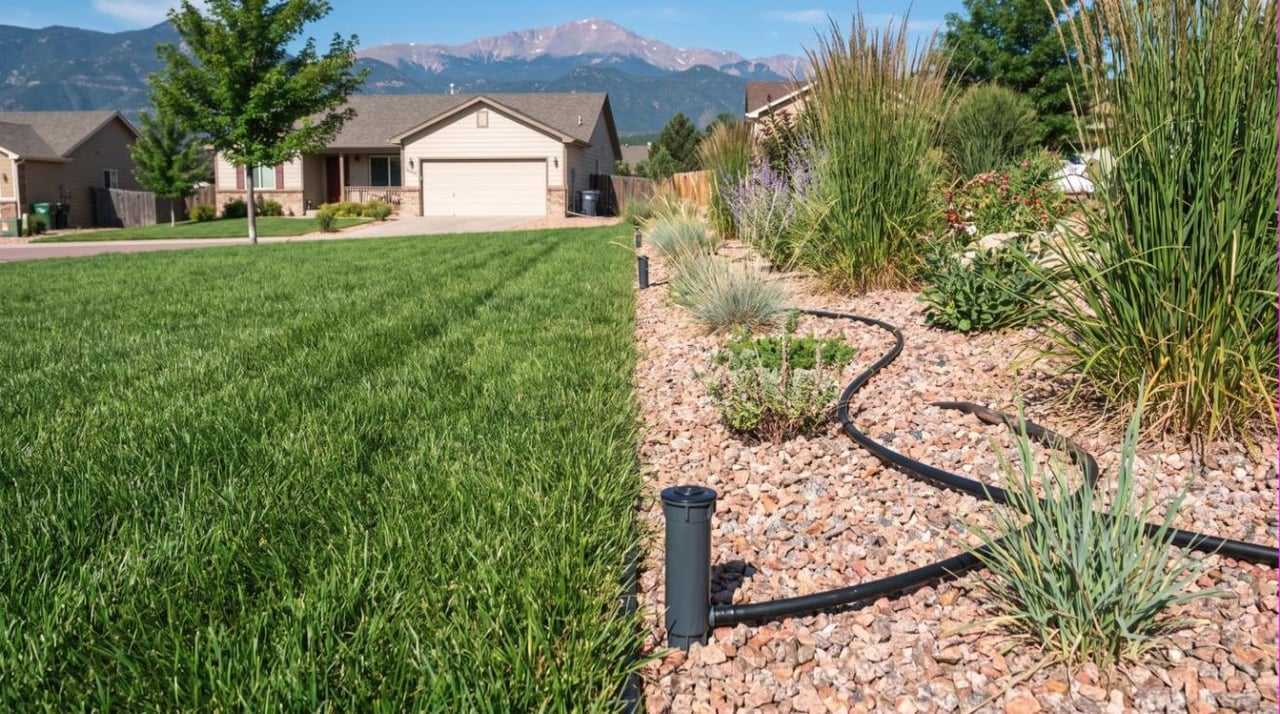
That handout says a violator "may be fined $100." Drip irrigation, a watering can, and a hose with a shut-off nozzle are allowed at any hour, per the City of Colorado Springs. New landscaping can get an establishment permit for extra days.
Here is what surprises buyers arriving from a Denver Water or Aurora Water address. There is no assigned watering day here. Nobody checks odd or even house numbers. You pick the three days.
The state turf law, and the part local coverage keeps getting wrong
Senate Bill 24-005 was signed March 15, 2024 and its main prohibition started January 1, 2026, per leg.colorado.gov. From that date a local entity may not install nonfunctional turf, artificial turf, or invasive plant species on what the statute calls applicable property: commercial, institutional or industrial property, common interest community property, and street rights-of-way, parking lots, medians and transportation corridors. Athletic fields are carved out.
Now the part I keep correcting on listing appointments. The signed bill says, in capitals, that "APPLICABLE PROPERTY DOES NOT INCLUDE RESIDENTIAL PROPERTY." Turf installed before the effective dates may stay. If a blog tells you Colorado is forcing homeowners to tear out bluegrass, that is not what the statute says.
House Bill 25-1113, signed May 20, 2025, goes further but still forward. It reaches multifamily buildings over 12 units starting January 1, 2028, and directs local entities to regulate turf in new residential development. Both bills govern what gets installed next. Neither governs the grass in your front yard.
Your HOA has less power than it had, and more than you would like
Senate Bill 23-178, signed May 17, 2023 and effective August 7, 2023, amends C.R.S. 38-33.3-106.5, the section of the Colorado Common Interest Ownership Act listing what an association cannot prohibit. An association shall not prohibit "the use of xeriscape, nonvegetative turf grass, or drought-tolerant vegetative landscapes," or vegetable gardens in front, back or side yards. House Bill 19-1050, signed March 7, 2019, had already extended those rights into limited common elements, subject to reasonable aesthetic standards.
The limits are specific. The association may not unreasonably require hardscape on more than 20% of the landscaping area, must allow an option consisting of at least 80% drought-tolerant plantings, and must select at least three preplanned water-wise garden designs preapproved for front yards. A refused owner can give 45 days notice to cure, then sue for the greater of $500 or actual damages. Read the exclusion before you celebrate: the subsection "APPLIES ONLY TO A UNIT THAT IS A SINGLE-FAMILY DETACHED HOME" and does not reach an attached home sharing a wall, or a condominium.
So the association keeps design review. It can require a submitted plan, hold you to a plant list, and reject your drawing. What it can no longer do is reject the category. Ask for those three preapproved designs in writing during your inspection period. I do this on Cordera contracts and on any resale where a buyer says the word xeriscape out loud.
The rebate arithmetic, and why this is not Aurora
House Bill 22-1151 created the state turf replacement program at the Colorado Water Conservation Board. The CWCB turf page now reads: "As of March 2025, CWCB is no longer accepting applications for the Turf Replacement Grant Program," and its FAQ says funding is expected to be exhausted after the round that closed February 28, 2025. Eligible applicants were governments, districts, tribes and nonprofits. Homeowners and HOAs did not qualify at any point.
Colorado Springs did well in the last cycle. The Colorado Sun reported on February 27, 2025 that the city received $462,234 of nearly $1.2 million awarded, then did the uncomfortable division: the top three grants, over $1 million combined, buy roughly 50 acre-feet of annual savings, near $20,000 per acre-foot. Jenna Battson, the CWCB's outdoor water conservation coordinator, told Water Education Colorado on February 28, 2024, "We know that it's not a cheap thing to do, but that's not necessarily a reason not to do it."
Here is what a CSU customer can get in 2026, from CSU's own pages:
Program | What it pays | Who qualifies |
|---|---|---|
Native Grass Lawn Program | Free native seed, free nozzles, classes | Residential water customers |
Sprinkler Nozzle Replacement | Free matched-precipitation nozzles | 2026 registration limit reached |
Sprinkler head rebate | $5 per head | Residential water customers |
New Home Landscape Incentive | $1 per square foot | New construction only |
Business Turf to Native | Up to $0.50 per square foot, $20,000 cap | Commercial accounts only |
Look at what is missing. I could not find a per-square-foot cash rebate available to an existing Colorado Springs homeowner removing an existing lawn. The $1 incentive is new construction, and it also requires a WaterSense certified smart controller, 70% ground plane coverage at maturity in planting beds, a yard sign, and a signed homeowner release. Aurora and Denver Water pay their own residential customers per square foot to remove turf. Colorado Springs Utilities, as far as its published pages show in August 2026, gives you seed and sprinkler parts.
What a lawn costs to run here, in dollars
CSU's residential rate sheet, marked as of July 1, 2026, sets the inside-city water service charge at $0.8512 per meter per day and the commodity charge at $0.0578 per cubic foot for the first 999 cf, $0.0721 for 1,000 to 2,499 cf, and $0.1083 at 2,500 cf or greater. Outside-city customers pay roughly 50% more. No drought surcharge appears on that sheet.
Denver Water published a benchmark I could not find a local equivalent for: 12 gallons per square foot per year is an efficient landscape, and "many customers use 18 gallons per square foot or more." That is a Denver figure, from a July 11, 2019 post. Treat it as a regional guide.
My arithmetic, using CSU's July 2026 rates and Denver Water's benchmark. A 2,000 square foot bluegrass lawn at 18 gallons per square foot drinks 36,000 gallons a season, about 4,813 cubic feet. Billed in the middle tier that is roughly $347, in the top tier roughly $521. Run it efficiently at 12 gallons and you land near 3,209 cubic feet, or $231 to $347.
The Colorado turf replacement task force, as reported by Water Education Colorado on February 28, 2024, put savings from replacement at about 12 gallons per square foot per year. On 2,000 square feet that is 24,000 gallons, worth roughly $231 to $347 a year at current rates. Take whatever a landscaper quotes and divide by that. That is your payback in years, and for most quotes I have seen it lands well north of a decade.
Rain barrels and graywater, and the ceiling on both
Colorado legalized limited residential rainwater collection through House Bill 16-1005, now C.R.S. 37-96.5-103. The Colorado Division of Water Resources states the terms: two barrels, 110 gallons combined, at a single-family residence or a building of four or fewer units, from rooftop downspouts, used outdoors where it fell, not for drinking or indoor use, with sealable lids. No permit is required. It is not a water right, and the State Engineer may curtail it.
Run that against the season. One hundred ten gallons is under half a percent of the 24,000 gallons an efficiently watered 2,000 square foot lawn uses. Rain barrels are worth doing. They are not a water strategy.
Graywater is shorter. CDPHE's Regulation 86 page states that the 2013 legislation "made graywater an opt-in program for local jurisdictions, not a statewide program," and that a city or county has to adopt its own ordinance first. Colorado WaterWise lists seven that have, between 2016 and 2022. Colorado Springs is not among them, and neither is El Paso County. Reusing shower or laundry water on your landscape is not authorized here.
New construction inherits strings a resale does not
Colorado Springs city code section 7.4.904 caps high water use turfgrass at 25% of total green space area and requires an irrigation plan, tied to development plan review. Whether that reaches a single detached lot or only the platted development around it is not something I could pin down from the code text. That one is a question for city planning.
The practical version: on a new build, the builder's approved landscape plan and the HOA's landscape guidelines both exist before you close, and they bind you afterward. Ask for both during your inspection period, and ask whether the builder claimed the CSU incentive on your lot, because it requires a homeowner release and a yard sign.
Pulling your own numbers before you touch the yard
Four free tools, and what each will not do.
- csu.org/water-wise-rules. The rules. No address lookup, because Colorado Springs assigns no watering day.
- Your CSU online account. Usage history and a bill calculator. Limit: it shows consumption, not which tier each cubic foot landed in.
- El Paso County Assessor property search, property.spatialest.com/co/elpaso. Lot size and subdivision name by address, free. Limit: it will not tell you whether an HOA exists.
- El Paso County Clerk and Recorder public records search, publicrecordsearch.elpasoco.com. Recorded declarations live here. Limits: the index runs on names, reception numbers and legal descriptions rather than street addresses, and I could not confirm whether images download free.
Colorado's Division of Real Estate runs an HOA Information and Resource Center at (303) 894-2166 where associations must register. Its own page says the center "does not investigate or intervene in disputes." It will not hand you covenants. Your title commitment will, and that is the document I read first. For the rest of the recurring-cost picture, I walked through the tax side in what your property tax bill really says.
Four things I could not pin down
A per-square-foot cash rebate for converting an existing Colorado Springs lawn: if CSU has one in 2026, it is not on the pages I could reach. Conversion cost per square foot here: every figure I found came from lead-generation landscaping sites with no disclosed methodology, so I am not publishing any of them. Whether CSU offers a free residential irrigation consultation: I confirmed the demonstration garden and the plant database, not an on-site visit. And whether the water tiers reset monthly. The rate sheet does not say. CSU's line at 719-448-4800 can settle that one.
If this were my yard, in August 2026
I would spend the first dollars on hardware, not demolition. Nozzles, check valves, pressure-reducing stems and a WaterSense controller cost a fraction of a conversion and cut the same bill. CSU's nozzle program filled for 2026, so set a reminder for the 2027 registration. Then I would convert the strip by the street and the south-facing side yard, not the whole lot. Those are the areas that die anyway.
And I would not buy a house on the theory that a rebate will fund the landscaping. In this territory, as of August 2026, it will not. Storage sits near three years against a 1.5-year surcharge threshold, so the pressure to change is coming from the weather rather than from your bill. Abby Ortega, general manager of infrastructure and resource planning at Colorado Springs Utilities, told Colorado Public Radio on March 19, 2026: "Even though our storage looks okay today, what's coming into our reservoirs this year is going to be less than what we're used to." If you are still weighing this market, I laid out the wider picture in my honest guide to moving here in 2026.
I'm Leah Behr, a REALTOR® with the Behr & Behr Team at The Platinum Group, Realtors. I cover everyday-life questions across El Paso County, from Fountain and Security-Widefield up through Falcon, Black Forest and Monument. Water rules are what buyers ask about in July and forget in January, which is exactly backward.
I am not a lawyer, an engineer, or a landscape contractor, and nothing here is legal advice. Rates, rebates and ordinances change. Verify with Colorado Springs Utilities at 719-448-4800, the City of Colorado Springs Planning Department, the Colorado Water Conservation Board, and any bill text at leg.colorado.gov. Check HOA covenants against the recorded declaration for your parcel. The Behr & Behr Team supports Equal Housing Opportunity, and we do not steer buyers toward or away from any community.