Around day three of the inspection period, a lot of my buyers get a text they were not expecting. The radon result came back at 6.2. Then the searching starts, and the internet hands them two things: an article built to frighten them and a contractor's quote form.
I'm Leah Behr, a REALTOR® with the Behr & Behr Team in Colorado Springs, and I have sat with clients through more radon results than I can count. This is the calm version. I am not a health professional and I am not a licensed radon contractor, so every figure below carries a named source.
Where radon comes from, and why Colorado has so much of it
Radon is a gas. You cannot see it, smell it or taste it. It forms as uranium, thorium and radium decay, and those elements sit naturally in small amounts in most rock and soil. Colorado's ground carries more of them than much of the country, and the rock changes sharply over short distances. The gas rises through soil and enters a house through foundation cracks, construction joints and openings around pipes and wires. The Colorado Geological Survey's conclusion: radon levels in homes are "strongly influenced by local geology" (Colorado Geological Survey, accessed July 2026).
EPA sorts counties into three zones. El Paso County is Zone 1, the highest, meaning a predicted average indoor screening level above 4 pCi/L (EPA, Map of Radon Zones, Colorado). EPA also warns that the map "should not be used to determine if individual homes need to be tested."
Which brings up the point I want to be loudest about. Two houses on the same street can test very differently. EPA's answer to whether a neighbor's result predicts yours is blunt: "It's not. Radon levels can vary greatly from home to home." Foundation type, what sits under the slab, how tightly the house is built, the weather during the test. All of it moves the number. EPA is equally direct about age: "Any home may have a radon problem. This means new and old homes, well-sealed and drafty homes, and homes with or without basements." So there is no radon neighborhood here. Pick where to live for the reasons that belong in that decision, which I cover in how to pick a neighborhood here, then test the house you put under contract.
What the El Paso County numbers actually say
The local figure, quoted exactly: "Over 40 percent of all homes tested between 2005-2023 in El Paso County had high levels of radon" (El Paso County Public Health, accessed July 2026).
Read that slowly. Homes tested. Not homes. People test because an agent suggested it or an inspection was already underway, so the tested pool is not a random sample of our housing stock, and no sample size is published. Elevated results are common here. The share across all our houses is unknown.
Statewide, CDPHE reports that roughly half of Colorado homes exceed the EPA action level of 4.0 pCi/L (CDPHE, January 5, 2026). The nuance nobody publishes: our county's tested-home rate sits slightly below that statewide figure, even though El Paso County is Zone 1. Both are self-selected samples. For scale, the average indoor level in American homes runs about 1.3 pCi/L and outdoor air about 0.4 pCi/L (EPA, A Citizen's Guide to Radon).
The health risk, stated carefully
Radon is the second leading cause of lung cancer overall and, in EPA's words, "the number one cause of lung cancer among non-smokers." On annual deaths, two federal sources disagree, and I would rather show both than pick. EPA attributes about 21,000 lung cancer deaths a year to radon. The National Cancer Institute estimates 15,000 to 22,000.
The interaction with smoking is what most coverage flattens. EPA publishes lifetime risk per 1,000 people exposed. At 4 pCi/L, about 7 people who never smoked could get lung cancer; among smokers at the same level, about 62. At 8 pCi/L, about 15 and about 120 (EPA lifetime risk tables). NCI says combined exposure to radon and cigarette smoke "creates a greater risk of lung cancer than exposure to either factor alone."
There is no floor. EPA: "Since there is no known safe level of radon, there can always be some risk." That is why the guidance does not stop at 4.0. But these are lifetime estimates. A number on an inspection report is information, not an emergency.
What your result means, and what to do about it
Result | How it compares | What EPA recommends |
|---|---|---|
Below 2.0 pCi/L | At or near the 1.3 pCi/L US indoor average | No action recommended. Retest every two years |
2.0 to 3.9 pCi/L | Above average, under the action level | "Consider fixing between 2 and 4 pCi/L" |
4.0 to 7.9 pCi/L | At or above EPA's action level | "Fix your home." Confirm with a second short-term test first |
8.0 pCi/L and above | Twice the action level or more | Fix. Never-smoker lifetime risk is near 15 in 1,000 here |
(EPA, A Citizen's Guide to Radon, 2016; EPA lifetime risk tables)
How the test works inside an inspection period
- Duration. A short-term test runs 48 to 120 hours, with CDPHE's floor at "a minimum of 2 days (48 hours)." Its brochure calls a real estate test "typically 2-5 days."
- Conditions. Exterior windows and doors shut for 12 hours before the test and throughout it, device placed on the house's lowest livable level (CDPHE; EPA).
- What ruins a test. An open window. A whole-house fan or evaporative cooler running, which pulls outdoor air through and does what an open window does. A vacant listing with a slider left cracked after a showing. No closed-house conditions, no valid result.
- Long-term testing. Alpha-track kits run 91 days to a year and give "a more representative picture of the true radon levels" (CDPHE). Too slow for an inspection period, and the version I recommend once buyers have the keys.
Section 10.3 of the Colorado Contract to Buy and Sell Real Estate (Residential) gives the buyer the right to inspections "at Buyer's expense," so the buyer pays for the test. Mitigation is separate. CDPHE: "The seller is not legally required to pay for mitigation; this is a negotiation between the buyer and seller, just like any other home repair."
Timing is what bites. The contract's Dates and Deadlines table carries three inspection deadlines: Inspection Objection, Inspection Resolution and Inspection Termination (Colorado Real Estate Commission, CBS1, January 2026 version). Your result has to land before the objection deadline, which is why I schedule the device with the general inspection rather than after it. Where two short-term tests get run, EPA's rule is to fix the home when their average is 4 pCi/L or more.
What Colorado law requires, and it is not a test
Colorado does have a radon disclosure law, and agents get it wrong constantly. Senate Bill 23-206 was signed June 5, 2023 and took effect August 7, 2023, codified at C.R.S. 38-35.7-112. A residential sale contract must contain, and a landlord must give tenants in writing, a warning about the dangers of radon and the need for testing, any knowledge the seller has of the property's radon history "including tests performed, reports written, and mitigation conducted," and the current CDPHE brochure (Colorado General Assembly, SB23-206). What it does not do is require anyone to test. No test, nothing to hand over.
The Commission revised four approved forms on that date, including the residential Contract to Buy and Sell and the Seller's Property Disclosure, and brokers must give buyers a copy of that brochure (Colorado Division of Real Estate, Broker Practice Advisory). In today's contract the language sits at Section 10.13, Radon Disclosure, in capitals, noting that CDPHE "STRONGLY RECOMMENDS THAT ALL HOME BUYERS HAVE AN INDOOR RADON TEST." Sellers: if you tested and mitigated, that paperwork is a disclosure item and a selling point. Hand it over early. I am not an attorney, so run your own situation past one.
Colorado licenses the people who do this work, too. House Bill 21-1195 created two licenses, radon measurement professional and radon mitigation professional, run by the Division of Professions and Occupations at the Department of Regulatory Agencies, and licensure has been required since July 1, 2022. Applicants must show certification from a proficiency program, which the statute defines to include the National Radon Proficiency Program, the National Radon Safety Board, or another program recognized by EPA. Unlicensed practice carries penalties (Colorado General Assembly, HB21-1195; DORA, August 16, 2022). Ask for the Colorado license number and check the state database. NRPP or NRSB certification is the usual route in; the state license is what makes the work legal.
What mitigation costs, and what it does
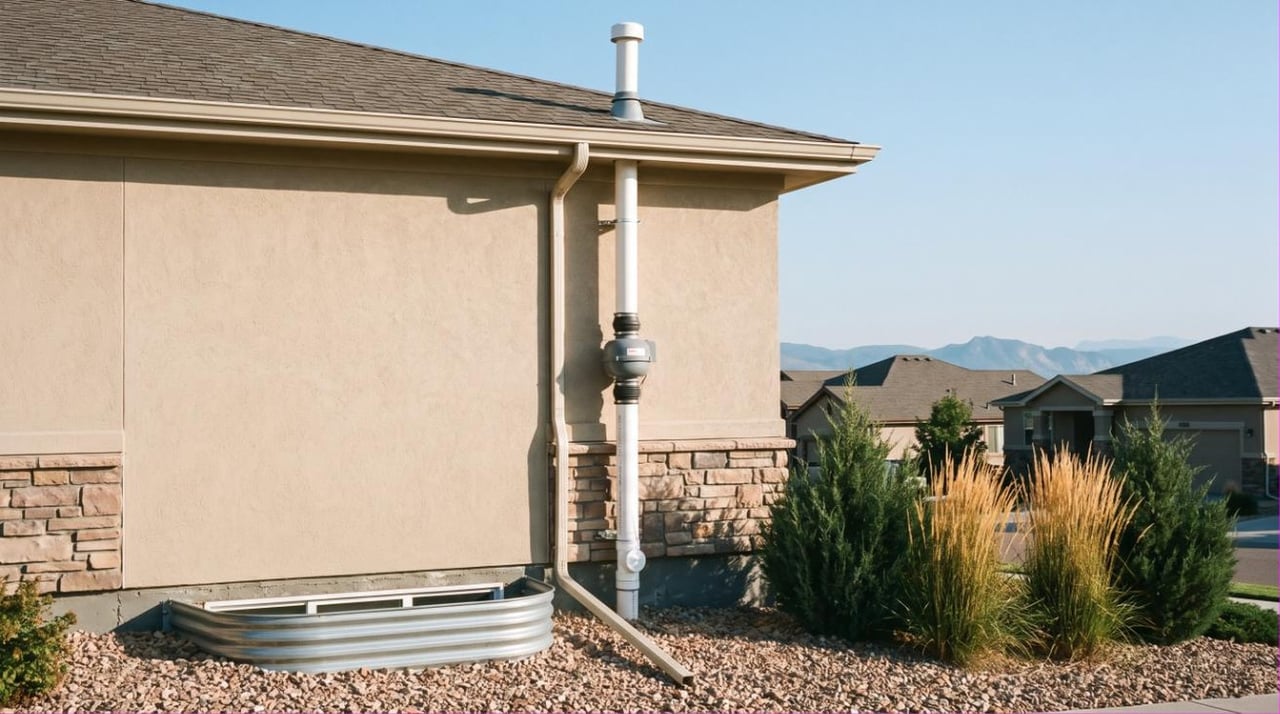
The standard fix is active soil depressurization: a pipe through the slab, or under a sealed membrane in a crawl space, connected to a fan that vents above the roofline. The fan drops air pressure under the foundation so soil gas goes up the pipe instead of into your living room. EPA calls active subslab suction "the most common and usually the most reliable radon reduction method" and rates its reduction at 50 to 99 percent depending on soil (EPA, Consumer's Guide to Radon Reduction, 2016). Foundation type changes the method, not the feasibility:
- Basement or slab-on-grade: subslab suction, drawing from the gravel or soil under the concrete.
- Crawl space: submembrane suction, sealing heavy plastic over the dirt and pulling from beneath it. EPA calls this "the most effective way to reduce radon levels in crawlspace homes."
- Mixed foundations: a slab addition off a basement, or a crawl space under part of the footprint, may need more than one suction point. That is what separates a routine bid from an expensive one.
All of these retrofit. CDPHE says mitigation "usually costs about $1,000 - $2,000," and its brochure lists an average U.S. installation cost of $1,500 with Colorado operating cost of $3 per month. No agency publishes a Colorado Springs figure, and I am not going to invent one. Get two or three bids, then verify the work: EPA calls for a post-mitigation test within 30 days and a retest every two years. Buying a house that already has a system? CDPHE says test it before purchase and every two years. An installed fan is not evidence of a low number. A dated test is.
CDPHE also runs a Low-Income Radon Mitigation Assistance program and points applicants toward HUD and USDA repair funding. Income limits are not posted, so call CDPHE at 303-692-2000. Testing yourself is cheap either way. The El Paso County Public Health laboratory at 1675 W. Garden of the Gods Road sells a short-term Air Chek test for $15, an alpha-track long-term kit for $42, and a radon-in-water test for $40, at (719) 578-3199. That last one measures water rather than air, and it is the price people most often mistake for an air test.
New construction and the code question everybody guesses at
I could not find a code requirement for a passive radon system in new El Paso County or Colorado Springs homes, and I went and read the code. Pikes Peak Regional Building Department is the building authority for both, and it enforces the 2023 Pikes Peak Regional Building Code incorporating the 2021 International Residential Code (PPRBD, accessed July 2026). That code says "appendices shall not be construed as provisions of this Code unless specifically adopted by the Jurisdiction," and the IRC's radon appendix is not referenced in PPRBD's residential materials. Radon does not appear in them at all.
So a passive rough-in here is a builder decision, not a mandate. Many builders install one anyway, but "the code requires it" is a claim I hear repeated locally and cannot verify. Ask your builder in writing whether one is going in and whether it can be made active later, and confirm current requirements with PPRBD. A stub-out during framing costs a fraction of a retrofit.
Your test came back at 6.2. Here is what I would do
Real number. Common number. Above the action level and nowhere near dramatic.
- Confirm it before you negotiate. Run a second short-term test and average the two, per EPA. Check that the first was actually held under closed-house conditions, because a surprising number are not.
- Get a bid, not an argument. Call a licensed mitigator for a written number before the objection deadline. Against CDPHE's $1,000 to $2,000 range, this is one of the least expensive findings an inspection can produce. Put it next to a roof or a sewer line and it stops looking frightening.
- Ask rather than demand. Three outcomes I see most: the seller installs a system and provides the post-mitigation test, the seller credits the cost at closing, or the buyer handles it afterward because the price already reflected the market. Which one you get depends on how much room you have, and with roughly 43% to 44% of local listings taking a price cut this summer (cospringsrealestatenews, July 10, 2026), buyers currently have some. Whether to spend it here is the judgment call I get into in the timing question.
- Do not treat it as a stigma. A mitigated house is a house with a known number and a documented fix. I would take that over a house nobody ever tested. Save the real objection for a system with no test history, or a result nobody documented.
Common questions
Is a radon test required when you buy a house in Colorado?
No. Colorado requires disclosure, not testing. Sellers must hand over what they know and include the CDPHE brochure, and the contract says the state strongly recommends a test, but nobody can compel one. EPA and the Surgeon General "recommend testing all homes below the third floor." A recommendation, not a rule.
How long does a radon test take during an inspection period?
At least 48 hours, typically 2 to 5 days for a real estate test, with exterior windows and doors closed 12 hours beforehand (CDPHE). Add read time, then book it alongside the general inspection so the result beats your objection deadline.
How much does radon mitigation cost in Colorado Springs?
CDPHE puts typical mitigation at about $1,000 to $2,000, with an average U.S. installation cost of $1,500. No agency publishes a figure for our market, and houses with more than one foundation type run higher.
Radon here is common, measurable, and fixable for roughly the cost of a decent appliance package. It is also one of the least dramatic things an inspection can turn up, which is the reverse of how it reads online. Test the house. Read the number. Get a bid if you need one. Then go back to deciding whether you like the kitchen. For anything touching your health, ask El Paso County Public Health at (719) 578-3199 or CDPHE, not a REALTOR® and not a blog post. If you are new here, radon belongs on the ownership list beside hail and expansive soil in the honest guide to moving here.
Leah Behr is a licensed REALTOR® with the Behr & Behr Team in Colorado Springs. She has lived here since 2009 and has walked buyers and sellers through radon results in every foundation type this county builds. Get in touch with our team if you want a second opinion on a result before your objection deadline.
Behr & Behr Team is committed to Equal Housing Opportunity. All information is deemed reliable but not guaranteed and should be independently verified. Nothing here is legal, medical or health advice. Confirm radon guidance with El Paso County Public Health and the Colorado Department of Public Health and Environment, and building code requirements with Pikes Peak Regional Building Department.