Eighty-five parts per million of calcium. Fifteen of magnesium. Those two lines in Security Water District's 2026 water quality report are the only hardness figures I could find in El Paso County.
I'm Leah Behr, a REALTOR® with the Behr & Behr Team in Colorado Springs, and the short answer is that hardness here depends on which utility serves your address, and for most addresses the number is not published at all. I spent a working day opening water reports and came back with one usable figure.
Hardness is missing from every El Paso County water report I could open
Every community water system has to send customers a Consumer Confidence Report, and the EPA's consumer page says those reports "must be sent by your water supplier each year by July 1."
I opened the 2026 editions, covering 2025 data, for Colorado Springs Utilities (PWSID CO0121150), Widefield Water and Sanitation District, Security Water District, the City of Fountain, Fountain Valley Authority, Woodmoor Water and Sanitation District, Woodmen Hills Metropolitan District and Cherokee Metropolitan District. Not one reports hardness. It is not a regulated contaminant, so nothing obligates a utility to print it.
The CSU report does describe sources: roughly 75 percent mountain surface water collected near Aspen, Leadville and Breckenridge, plus local surface sources, plus purchased Fountain Valley Authority water, which the FVA report calls "surface water received from the Fryingpan-Arkansas Project," stored in Pueblo Reservoir. Different water, different mineral load, blended in proportions the report does not break out by service area.
If a page online hands you one Colorado Springs hardness number with no citation, ask where it came from. The confident numbers I found came from companies that sell softeners.
Two hardness scales, and they disagree about what counts as soft
The U.S. Geological Survey's Water Science School page on hardness, last updated June 11, 2018, uses four bands in milligrams per liter as calcium carbonate. Woodmoor Water and Sanitation District posts its own hardness sheet using five bands it credits to the U.S. Department of the Interior and the Water Quality Association. It also gives the conversion: "One grain of hardness equals 17.1 mg/l or ppm of hardness."
Category | mg/L as CaCO3 | Grains per gallon |
|---|---|---|
Soft | 0 to 17.1 | 0 to 1 |
Slightly hard | 17.1 to 60 | 1 to 3.5 |
Moderately hard | 60 to 120 | 3.5 to 7.0 |
Hard | 120 to 180 | 7.0 to 10.5 |
Very hard | 180 and up | 10.5 and up |
Woodmoor's sheet carries no date I could see. The USGS bands are wider at the bottom: 0 to 60 is simply soft, 61 to 120 moderately hard, 121 to 180 hard, above 180 very hard. A 40 mg/L sample is soft to the USGS and slightly hard on the other scale. When someone quotes you a category instead of a number, ask which scale.
Security Water District, and the one number I could actually calculate
Security's 2026 report lists calcium at 85 ppm and magnesium at 15 ppm, both sampled in 2023, each with a range equal to itself. The same figures appear in Security's own report and in Fountain's and Widefield's combined 2026 reports. Sodium is listed at 42 ppm.
Total hardness as calcium carbonate is calcium times 2.497 plus magnesium times 4.118, those multipliers being ratios of molar masses. My arithmetic, on Security's published figures: about 274 mg/L, or roughly 16 grains per gallon. Very hard on either scale, by a wide margin. Two caveats. A range equal to a single value suggests one sample, three years old relative to the report. And Security buys treated surface water too, so a tap there receives a shifting blend.
Now the part where I decline to help. Woodmoor reports sodium at 24.41 ppm for 2025, Cherokee at 56.97 ppm, Woodmen Hills at 109.67 ppm for 2022. Sodium is not hardness, and I will not convert one into the other to manufacture a north county figure. The single documented very hard system here sits in the south, which is the opposite of what I assumed going in.
Wells, and the test the county lab does not sell
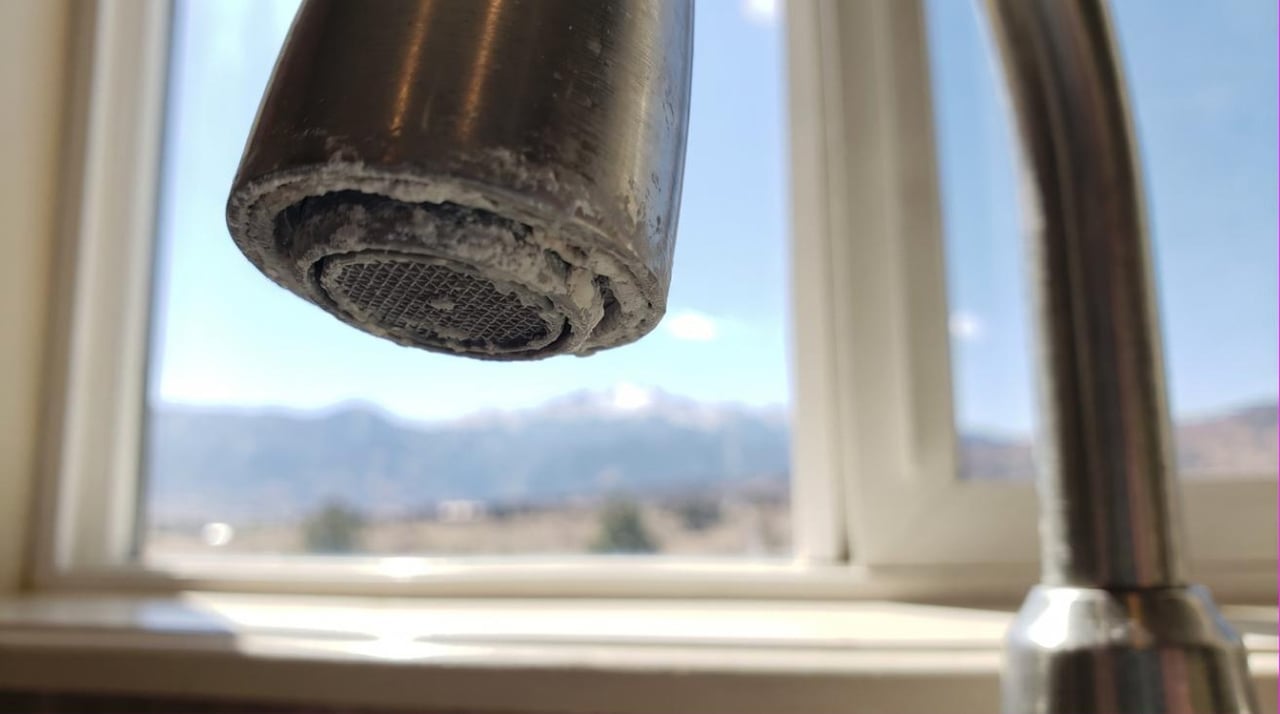
Roughly 30,000 properties in El Paso County are on septic, and many of those are on wells. Nobody publishes a countywide well hardness figure.
El Paso County Public Health runs a water lab. Its published fee page lists bacteriological testing at $23.00, individual anion tests at $30.00 each, plus a "Real Estate Package: Bacteriological, Nitrate-N, Nitrite-N $80.00." Hardness appears nowhere on that list. The $80 package your lender asks for tells you nothing about scale.
The state lab is not the backup you would hope for. CDPHE's water testing page says it has "temporarily suspended water chemistry testing" and points customers to accredited commercial labs through its certified lab lookup at cdphe.colorado.gov/dwlabs. That lookup is the free tool a well owner should use. While you are ordering, our post on radon in Colorado Springs homes covers the other test I would not skip out here.
Scale in a tank, worse in a tankless, and the studies I could not read
Christina Devine, Fei Wang and Marc Edwards, the last a professor of civil and environmental engineering at Virginia Tech, published "A Standardized Test Protocol for Evaluation of Scale Reduction Technologies" in Environmental Engineering Science on October 27, 2021. Their opening line carries the weight: "Precipitation of calcium carbonate (i.e., scaling) can occur in both traditional tank (electric and gas) and 'green' tankless hot water systems."
The percentages circulating online trace to work commissioned by the Water Quality Research Foundation, including a Battelle Memorial Institute study on water heater efficiency. The public pages carry summaries; the reports sit behind a Water Quality Association member paywall. WQA describes itself as "the leading voice of the residential, commercial, industrial and small community water treatment industry, representing more than 2,500 manufacturers, suppliers and dealers worldwide." That is a trade group funding research into its members' products. The work may be sound. I could not read it, so I will not repeat its numbers.
The softener decision, without a salesman's arithmetic
The Virginia Tech protocol tested seven scale control approaches. Salt-based cation exchange, the conventional softener, cut scale by 99.8 percent. Electrochemical deionization reached 99.1 percent. Phosphate sacrificial media managed 54.1 percent and citric acid media 47.3 percent. Physical magnets came in at 5.2 percent. Electric field generators, 4.4 percent.
Read that spread. Ion exchange works. The physical and electrical conditioners marketed as salt-free alternatives did close to nothing. I could not confirm that template-assisted crystallization was among the seven, so I am not assigning it a number. The study was co-funded by the same foundation I flagged above, and run by an academic lab with a record of publishing findings the water industry disliked.
On cost I will disappoint you. I found no purchase price, installation range, salt cost or regeneration water volume for Colorado Springs from any source that was not selling equipment, so I am not publishing one. Woodmoor's sheet does document the tradeoff: ion exchange adds sodium at roughly 8 mg/L per grain removed, and softened water "is not recommended for watering plants, lawns, and gardens." At Security's 16 grains the equipment-protection case is strong on its own. For a CSU customer it is unproven, because the utility has published no number to build a case on. Test first, buy second.
Salt down the drain, and the septic argument I could not settle
The Virginia Tech paper notes that hardness removal produces "a net addition of salt to the water discharged from homes using softeners that increases the salinity of receiving waters." That is a watershed-scale concern, and elsewhere in the country it is why some jurisdictions restrict self-regenerating units. I could not confirm that any El Paso County wastewater utility restricts or discourages them, or that any Colorado jurisdiction has banned them. The Secretary of State's rule page for Colorado's Regulation 43 would not load for me, and county septic pages say nothing about softeners that I could find.
Industry-funded field work has generally concluded that softener discharge does not harm an on-site system and may add useful volume and calcium. The countervailing concern is hydraulic loading and salinity in the soil treatment area. I am not picking a winner on evidence I could not read in full. If you are on septic, call El Paso County Public Health at 719-578-3199 first.
What an inspector will not say about the water heater
People assume the general inspection covers this. It does not. The InterNACHI Standards of Practice, section 3.6, say the inspector is not required to "determine the water quality, potability or reliability of the water supply or source," not required to "inspect water treatment systems or water filters," and not required to "measure the capacity, temperature, age, life expectancy or adequacy of the water heater."
So ask the two questions no report answers. How old is the water heater, which you can usually decode from the serial number on the data plate. And has it ever been flushed. If a softener is present, ask whether it is owned or leased, because a lease is a contract that gets handled at closing.
Running the address, and running the tap, before you write
- Find the utility. Use the EPA's Consumer Confidence Report search at ordspub.epa.gov/ords/safewater/f?p=136:102 to identify the system. Limit: it indexes systems, not street addresses, so in a mixed area like Falcon confirm against the seller's water bill.
- Read the report anyway. Woodmen Hills posts reports back to 2018, and Woodmoor, Cherokee, Donala, Security, Widefield and Fountain post current ones. Limit: hardness will almost certainly not be there.
- Test at a showing. A hardness strip kit runs somewhere around ten dollars at a hardware store, and I found no published price list to cite, so treat that as my observation. Ask the listing agent first. Run the kitchen tap, then an outdoor hose bib, which is often plumbed upstream of a softener. A near-zero kitchen reading beside a high hose bib reading tells you a softener is installed.
- On a well, order a real panel. Use cdphe.colorado.gov/dwlabs. The county's $80 package does not include hardness.
None of this changes what you offer. It changes what you expect to spend in year one. If you are still forming a picture of the area, our look at what it is really like to live in Colorado Springs covers the rest.
The blanks I am not filling in with guesses
Colorado Springs Utilities' hardness, in any unit. Monument, Palmer Lake and Academy Water and Sanitation, whose sites blocked my requests. Donala, whose combined 2026 report with CSU is posted as a scan I could not read. Softener price, salt and regeneration figures from a source not selling softeners. The efficiency percentages behind the industry studies. Any Colorado or El Paso County rule on self-regenerating softeners. Template-assisted crystallization. The current Colorado seller's disclosure text. Eight open items in a post with one hard number in it.
Where I would spend, and where I would wait
I would call the utility on the seller's water bill and ask a person for the hardness number, because the report will not have it. I would ask the age of the water heater and whether it has been flushed, and treat "I don't know" as a maintenance signal rather than an insult. On a well I would add a hardness panel through a state-certified lab. And I would not buy treatment equipment during the inspection period. Close, live with the water a month, test, then decide.
I'm Leah Behr, and I write our everyday-life posts because these are the things buyers ask about in the car between showings. Want the current report pulled for a specific address? That takes me fifteen minutes.
I am a REALTOR®, not a plumber, engineer, water treatment professional, laboratory analyst or attorney, and none of this is engineering, health or legal advice. Verify hardness with your provider, with El Paso County Public Health at 719-578-3199, and with a laboratory certified by the Colorado Department of Public Health and Environment. Figures are current as of August 2026 and these reports update annually. The Behr & Behr Team supports Equal Housing Opportunity and does not steer buyers by neighborhood, district or provider.