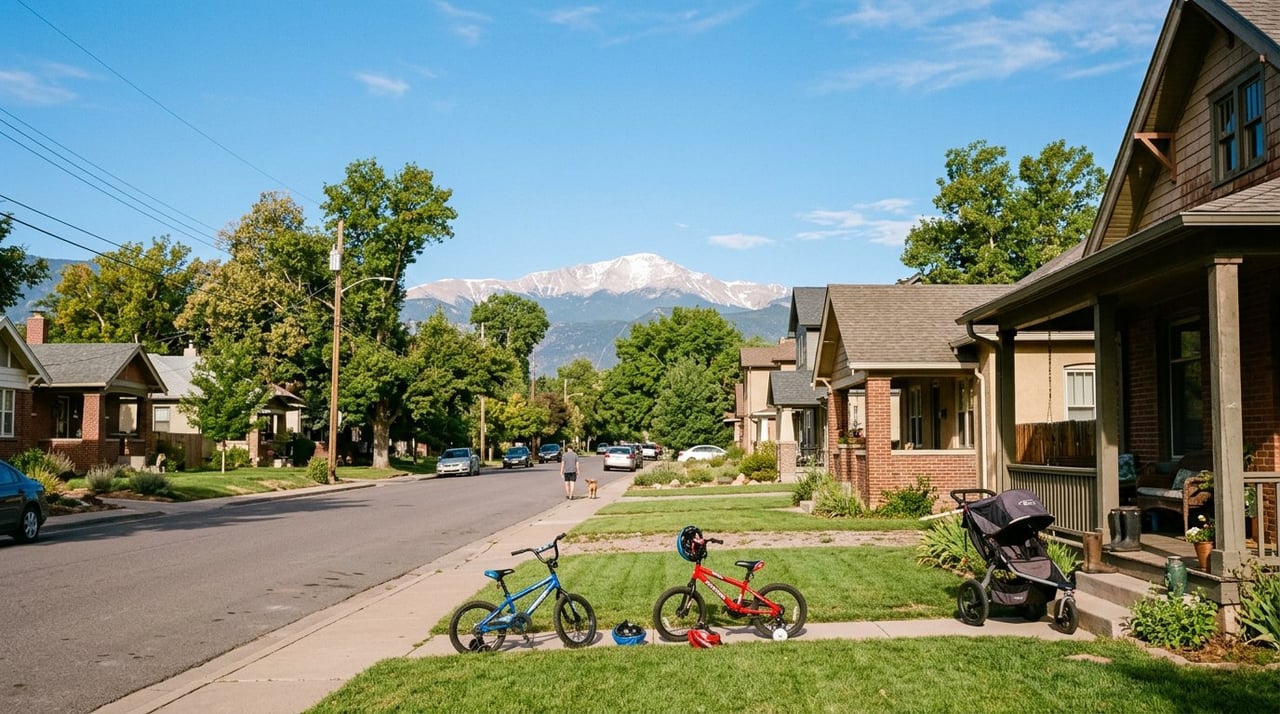
Most pages answering this question were written by someone who has never spent a March here. I'm Leah Behr, a REALTOR® with the Behr & Behr Team, and I moved to Colorado Springs in 2009. What follows is the stuff I actually tell people: the texture of the week rather than the brochure.
If you want the money side, I wrote that separately in the honest guide to moving here. This is everything else.
The weather, described correctly for once
Here are the actual thirty-year normals from the weather station at the airport. Three things in this table surprise almost everyone.
Month | Avg high °F | Avg low °F | Precip (in) | Snow (in) |
|---|---|---|---|---|
January | 45.0 | 18.5 | 0.29 | 4.9 |
February | 46.5 | 20.2 | 0.32 | 4.6 |
March | 54.9 | 27.3 | 0.79 | 5.7 |
April | 61.0 | 34.0 | 1.45 | 5.5 |
May | 70.7 | 43.5 | 1.99 | 0.6 |
June | 81.6 | 52.8 | 2.27 | 0.0 |
July | 86.5 | 58.2 | 3.12 | 0.0 |
August | 83.6 | 56.6 | 2.96 | 0.0 |
September | 77.1 | 48.9 | 1.35 | 0.2 |
October | 64.7 | 36.6 | 0.77 | 2.5 |
November | 52.9 | 26.0 | 0.37 | 4.4 |
December | 44.6 | 18.7 | 0.23 | 4.1 |
Source: NOAA National Centers for Environmental Information, 1991–2020 monthly climate normals, station USW00093037 (Colorado Springs Municipal Airport). Annual totals of 15.91 inches of precipitation and 32.5 inches of snow are my arithmetic on NOAA's monthly figures.
March is the snowiest month, not January. Winter here is back-loaded. March averages 5.7 inches and April 5.5, while January manages 4.9. The heaviest snow I have shoveled was in April. People arrive braced for a brutal January and get caught by spring.
July is the wettest month. More than half the year's precipitation falls between June and August, because the North American Monsoon pulls moisture up from the Gulf of California and afternoon thunderstorms become close to a daily event. It builds around two o'clock, dumps, and clears. You plan hikes for the morning.
Every single month has an average high above freezing, including January, at 45°F. That is the structural reason snow does not sit here the way it does in the Midwest. March and April afternoons average in the mid-50s to low 60s, so even the snowiest months are melting between storms.
The number that actually matters is the swing
The average gap between the daily high and the daily low is about 27°F, and it barely changes across the year, from roughly 26°F in December to 29°F in June (my calculation from the NOAA normals above). A 55-degree January afternoon routinely follows an 18-degree dawn. You will dress for the wrong half of the day for about a year, and then you will start keeping a jacket in the car permanently like everyone else.
"Average snowfall" is a nearly useless number here
The monthly normals above add up to 32.5 inches a year. But the National Weather Service's seasonal records for Colorado Springs run from 12.7 inches in 2010–11 to 89.4 inches in 1956–57. That is a sevenfold range. Nobody here has ever lived through an average winter.
Do not plant tomatoes in April
The mean date of the last spring freeze is May 8, and the mean first fall freeze is October 1, a growing season of about 146 days. The record for the latest measurable snow is 1.1 inches on June 10, 1975 (NWS Pueblo). Every transplant loses a first round of seedlings to a May freeze. Consider this your warning.
The dryness is the thing that actually changes your day
This is what I wish someone had told me, and it almost never appears in relocation content.
Afternoon relative humidity here averages 40% across the year, and bottoms out at 34% in June (NOAA Comparative Climatic Data, station 93037). For comparison, from the same dataset, Denver runs 43% in the afternoon. Colorado Springs afternoons are drier than Denver's.
In our house that means nosebleeds every winter, when forced-air heat strips out what little moisture is left. Children's Hospital Colorado puts it plainly. Dryness of the nasal lining makes it more likely to bleed, and recommends running a humidifier and, for front-of-nose scabbing, a dab of petroleum jelly twice daily for no more than a week. We run humidifiers from October to April and it is not optional.
It also changes how you cook. At about 6,000 feet water boils near 202°F rather than 212°F, so anything simmered or braised takes longer. Colorado State University Extension estimates meats may need roughly 25% more time at 5,000 feet, and hard-boiled eggs go from about three minutes to five. For baking below 6,500 feet, CSU Extension's adjustments are: decrease baking powder by 1/8 teaspoon per teaspoon, decrease sugar by up to a tablespoon per cup, add one to two tablespoons of liquid per cup, and raise the oven 15 to 25°F. And cover things while they cook, because the dry air pulls moisture straight out.
The one with an actual safety consequence: pressure canning low-acid foods between 4,001 and 6,000 feet requires 13 pounds of pressure to reach 240°F (CSU Extension). If you can vegetables, that is not a preference.
The sun, honestly
You will hear "300 days of sunshine" from realtors, neighbors, and roughly every relocation site. It is not true. The airport records an average of 127 clear days and 120 partly cloudy days a year, and 118 fully cloudy ones (NOAA Comparative Climatic Data). The Colorado Sun ran the numbers statewide and found Denver at around 252 sunny days; none of the Colorado cities it checked exceeded 300.
It is genuinely sunny. It is not 300-days sunny, and I would rather you hear that from me than work it out in your second February.
October is the sunniest month, with 15 clear days, and September is second with 14. July has the fewest clear days of any summer month, because of the monsoon. If someone tells you to visit in July to see the place at its best, they have it backwards. Come in late September.
On UV: the EPA's figure is that ultraviolet intensity rises about 2% per 1,000 feet of elevation, which works out to roughly 12% more UV here than at sea level. That is real but modest, and a lot of local content inflates it into something dramatic. The honest version is that a modest UV increase combined with an outdoor-oriented population and 247 clear-or-partly-clear days adds up. A local meteorologist reports the regional UV index peaking around 8, where unprotected skin can burn in about ten minutes. Wear sunscreen in February. Everyone here learns that once.
Wind
People warn you about the wind, and the averages do not back them up. The annual average wind speed is 9.5 mph, with April the windiest month at 11.5 (NOAA CCD). Chicago's annual average, from the same dataset, is 9.9, higher than ours.
What makes wind memorable here is not the average, it is the peaks. The station's recorded maximum is 80 mph out of the west, in January. The strongest winds arrive in winter, off the mountains; the consistently breezy season is March through May. A February 2026 windstorm produced gusts near 80 mph across the region.
The reason this matters more than it sounds: wind plus dry fuel is how a grass fire becomes a neighborhood fire. The city's own wildfire readiness material names the Marshall Fire as its model for fast-moving wind-driven urban wildfire, and flags that traffic congestion west of I-25 would complicate evacuation. Wherever you buy, look up your address on the city's Wildfire Ready page and know two ways out. The city's own planning material notes that congestion on the west side of I-25 would complicate an evacuation.
Where people actually go outside
Garden of the Gods is free, and it is free permanently. It was gifted to the city in 1909 on the condition it remain "forever open and free to the public." It also takes over four million visitors a year, and the Central Garden parking lot at noon on a Saturday is a genuine trial. There is no reservation system; the city runs a free summer shuttle instead. Locals park in the overflow lot across 30th Street and walk, or skip the paved central loop entirely for Palmer Trail and the Siamese Twins.
The Manitou Incline now requires a free timed reservation. No walk-ups. That system is permanent. The city kept it after search-and-rescue calls dropped from roughly 58 a year to under 20. Parking is the part people get wrong: Hiawatha Gardens or the Iron Springs lot, and parking on Ruxton Avenue or at the Barr Trail lot is prohibited for Incline hikers. Book through the city's reservation page rather than trusting posted hours you find in search results, which have changed repeatedly, and several COVID-era city pages are still circulating.
The places residents actually use most days are quieter: Ute Valley Park in the northwest, Palmer Park in the middle of the city, Red Rock Canyon Open Space on the west side, Bear Creek Regional Park with its dog park and nature center, and Section 16 off Gold Camp Road if you want a hard 5.5-mile loop with 1,200 feet of climb. If you want a sense of what trail access does to a neighborhood day to day, I wrote about Mountain Shadows and its trailheads separately.
A gotcha worth knowing before your first DMV visit. The Keep Colorado Wild Pass costs $29 and is added to your vehicle registration by default, so you have to opt out. It covers entry to every Colorado state park, including Cheyenne Mountain State Park inside the city's southern edge, and it is a fraction of the $80 standalone annual pass. Most people either do not realize they bought it or do not realize they have it. Same-day reversals are available at any DMV office.
A Saturday with a small child
I have a toddler, so this is the part of the week I know best.
The single strongest free amenity in this city is the library. Pikes Peak Library District runs 14 branches serving more than 650,000 people across El Paso County, with storytime programming throughout. Library 21c on Chapel Hills Drive was described at its 2014 opening as the first of its kind in the country: makerspaces, a recording studio, a café, a performance space. The Old Colorado City branch still operates out of its 1904 Carnegie building.
For playgrounds, the two worth driving across town for are John Venezia Park in the north, whose "Corral" is a universally accessible playground, and Panorama Park in the southeast, redesigned with an all-abilities playground and a splash pad with community-made tile work. Downtown, America the Beautiful Park has the Julie Penrose Fountain and Acacia Park has the Uncle Wilber Fountain, both of which will absorb a hot afternoon.
Now the honest part: there is no large purpose-built children's museum here on the scale of Denver's. What exists is the Space Foundation Discovery Center, a franchise play museum, the new Jungle Reef aquarium at Chapel Hills Mall, the U.S. Olympic & Paralympic Museum, and Cheyenne Mountain Zoo, which is marking its centenary in 2026 with a new giraffe center. On a bad-weather Saturday in February, that gap is real and local parents feel it.
On altitude with small children: the thing to understand is that Colorado Springs sits below the elevation where altitude sickness normally begins. UCHealth's high-altitude clinic director notes that acute mountain sickness runs 15 to 40% among visitors sleeping at 8,000 feet or higher, and specifically recommends stopping in Denver or Colorado Springs overnight to acclimate before going higher. We are the acclimation stop, not the problem. The day trips are a different matter. Taking a toddler from 6,000 feet to the 14,115-foot Pikes Peak summit inside an hour is a genuinely different proposition, and the cog railway's own site offers no altitude guidance at all.
Three things that surprise new homeowners
Radon, and this one is specific to this county
This is the most important practical item in this entire post. Over 40% of all homes tested in El Paso County between 2005 and 2023 had elevated radon levels, and both the county and the state sit in EPA Zone 1, the highest-potential category (El Paso County Public Health).
Test kits are cheap and available from the county public health laboratory on West Garden of the Gods Road: $15 for a short-term air test, $42 for a long-term alpha-track kit, $40 for radon in water. Discounted state kits are offered in January, and CDPHE runs mitigation assistance for low-income households. I raise this on every transaction, and I would test regardless of what a seller's disclosure says.
Bears, and there is an actual ordinance
Colorado Springs has had a bear-resistant trash ordinance since March 2020, and it applies to most areas west of I-25. You either keep bins in a garage or secure structure and put them out only on collection day between 5 a.m. and 7 p.m., or you use a certified bear-resistant container. Recycling bins are exempt. Fines run $100, then $250, then $500.
Colorado Parks and Wildlife reported 219 human-bear incidents through June 11 of this year, 215 of them since April 1 (as reported by KKTV; the agency did not specify whether that count is local, regional or statewide), after a dry winter pushed bears toward easy calories. A district wildlife manager put it simply: everything west of I-25 is decent bear habitat. Take bird feeders in every evening, because bears travel at night.
Proportion matters here. Deer in the yard is routine. Bears west of I-25 are a trash-management problem rather than a danger problem. Mountain lion attacks are genuinely rare, 29 in Colorado since 1990, and the most recent fatality was near Estes Park, well over a hundred miles away. Keep dogs leashed on trails and you have handled most of it.
You cannot water whenever you like
Colorado Springs Utilities' Water Wise Rules took effect May 1, 2026: a maximum of three days per week of outdoor watering, and no watering between 10 a.m. and 6 p.m. The utility described this year as water shortage preparation, expecting yield to come in at less than half of normal after an unusually low snowpack. Check the current rules on the utility's own page before you plant a lawn you cannot keep alive.
What residents actually say
Rather than quote a relocation blog, here is the city's own 2024 community satisfaction survey, conducted by the ETC Institute, with 625 randomly sampled residents, margin of error about 3.9%.
The four things residents were most satisfied with, in order: snow removal on city streets, the number of city parks, the city's support for local military, and fire protection. Snow removal topping that list is the single most counterintuitive finding in the whole survey, and it is exactly backwards from what someone worried about a Colorado winter would expect.
And the things they were not satisfied with. Only 14% were satisfied with the maintenance of major city roads, against 60% who called it important, and residents named roads their single top priority. 52% were dissatisfied with the city's crime prevention efforts, and residents ranked crime prevention, police protection and traffic enforcement as their top three public safety priorities.
I am not going to characterize any part of town for you, and you should be skeptical of anyone who does. What I will say is that road quality and public safety funding are live, contested civic issues here, and if you are moving from a city with a bigger tax base you will notice the roads.
The arguments happening right now
Two live ones, because they tell you more about a place than a list of amenities.
The Ford Amphitheater. An 8,000-capacity venue opened in the north of the city in August 2024 and has generated thousands of noise complaints. Eight residents in Northgate Highlands and unincorporated El Paso County, some up to two miles away, sued the operators in January 2026, documenting 11 concerts exceeding Colorado's 50-decibel residential cap, with recordings up to 71 decibels. The city issued a third noise hardship permit in May 2026. If you are buying in the far north, ask about it.
Growth and water. In June 2025 the proposed Karman Line annexation, about 1,900 acres and 6,500 homes on the southeast edge, went to a public vote after council approved it, and voters rejected it 82% to 18%. Opponents' central argument was water. That result tells you something durable about how this city currently feels about outward growth.
Is Colorado Springs a good place to live?
After seventeen years, my honest answer is yes for a specific kind of person and no for another, and it is worth knowing which one you are before you sign anything.
It works if you will actually use the outdoors, if you can tolerate driving for most things, and if you are bringing income with you rather than competing for it locally. It works less well if you wanted a walkable city, if you need a deep specialist job market, or if you are arriving expecting the cheap Colorado of a decade ago. The full cost picture is in the moving guide.
Common questions
What is it actually like living in Colorado Springs?
Spread out, car-dependent, and organized around the outdoors more than around downtown. Most of your life happens inside one quadrant of the city. Winters are milder than the reputation and back-loaded toward March. Summers bring afternoon thunderstorms and hail. The air is dry enough that you will change how you cook and sleep with a humidifier. It rewards people who go outside and frustrates people who wanted a walkable city.
What is the weather like in Colorado Springs year round?
Average highs run from 45°F in January to 86°F in July, with lows from 18°F to 58°F. Snow averages 32.5 inches a year but has ranged from 12.7 to 89.4 inches across recorded seasons. March is the snowiest month; July is the wettest. Every month has an average high above freezing, so snow rarely lingers (NOAA 1991–2020 normals).
Is Colorado Springs dry?
Yes, and more than Denver. Afternoon relative humidity averages 40% annually and drops to 34% in June, against Denver's 43% (NOAA Comparative Climatic Data). Expect nosebleeds in the first winter, plan on humidifiers, and adjust your baking.
Does Colorado Springs really get 300 days of sunshine?
No. The airport averages 127 clear days and 120 partly cloudy days a year, along with 118 fully cloudy ones. That claim is marketing, not meteorology, and it circulates so widely that residents repeat it in their own reviews of the city.
What surprises new homeowners here most?
Test for radon. Over 40% of tested El Paso County homes came back elevated. Learn the watering rules before you plant. If you buy west of I-25, learn the bear ordinance and your wildfire exit routes. Do not plant before mid-May. And expect the roads to be worse than you are used to; residents rate them the city's weakest service by a wide margin.
What is Colorado Springs like with young kids?
It has real strengths: a 14-branch library district, an unusually good stock of accessible playgrounds, and enough space that kids end up outside. It also has genuine gaps, most obviously the absence of a major children's museum for the bad-weather months. Which part of town suits you depends on your commute and your daily routine. School district boundaries do not follow ZIP codes, so check the district's own address lookup before you assume anything, which I go through in the neighborhood guide.
Living in Colorado Springs: the honest pros and cons
What I would tell a friend: this is a city that pays you back for going outside and charges you for expecting convenience. The roads are genuinely bad. The dryness is a bigger daily adjustment than the altitude. The winter is easier than you fear and the spring is harder. And the thing that keeps people here is not any single amenity. It is that a Tuesday afternoon can include a trailhead.
If you are trying to work out whether it fits, come on a weekday in February rather than a weekend in July. That is the version of this place you will actually be living in.
Leah Behr is a licensed REALTOR® with the Behr & Behr Team in Colorado Springs. She has lived here since 2009 and sells across the Pikes Peak region. If you want an honest read on a neighborhood before you commit to it, get in touch with our team.
Behr & Behr Team is committed to Equal Housing Opportunity. All information is deemed reliable but not guaranteed and should be independently verified.