Buyers budget the mortgage, the property taxes, usually the HOA. Then the insurance quote lands at two or three times what they paid in Texas or Ohio, and the spreadsheet gets rebuilt on a Tuesday afternoon.
I'm Leah Behr, a REALTOR® with the Behr & Behr Team in Colorado Springs, and this line item blindsides more of my relocating clients than any other. I am not an insurance agent and none of this is insurance advice. But I can show you what the state's own data says is driving the number.
The published averages disagree by $1,436
Three comparison sites published a Colorado Springs average in the last ten weeks. They do not agree, and treating any single one of them as "the" cost of insuring a house here is misleading. None of these are regulator figures. They are modeled quotes, and the spread between them is wider than most people's actual annual increase.
Modeled quotes from comparison sites, not regulator data. The MoneyGeek row assumes a lower dwelling limit, so these three figures are actually not comparable. | |||
Source | Average annual premium | Coverage assumed | Updated |
|---|---|---|---|
Insurify | $4,368 | $300,000 dwelling, $1,000 deductible | July 15, 2026 |
Insure.com, using Quadrant Information Services | $5,804 | $300,000 dwelling, $100,000 liability, $1,000 deductible | May 27, 2026 |
MoneyGeek | $4,343 | $250,000 dwelling, $1,000 deductible | May 21, 2026 |
The first two rows describe essentially the same policy in the same city and land $1,436 apart. MoneyGeek looks close to Insurify, but assumes a $250,000 dwelling limit, so it is not the same house. And Insure.com's own page names State Farm cheapest here at $2,585, less than half its own city average (Insure.com, May 27, 2026).
Those are comparison sites, not regulators, and I could not find an El Paso County average published by the Division of Insurance in retrievable form. The spread between the low and high quote on one address beats the spread between cities. An average tells you almost nothing.
Your old rate is no guide either. Colorado premiums are up 100.8% since 2019, the largest increase of any state (LendingTree via The Colorado Sun, July 11, 2026). The state now ranks sixth most expensive for homeowners coverage (Office of Governor Jared Polis, April 2026; also CSU REDI report, August 2025). Building costs are up 42% per square foot since 2019 (Insurify analyst Matt Brannon, via The Colorado Sun, July 11, 2026), which is why old limits go stale.
Hail is the line item, and wildfire is not close
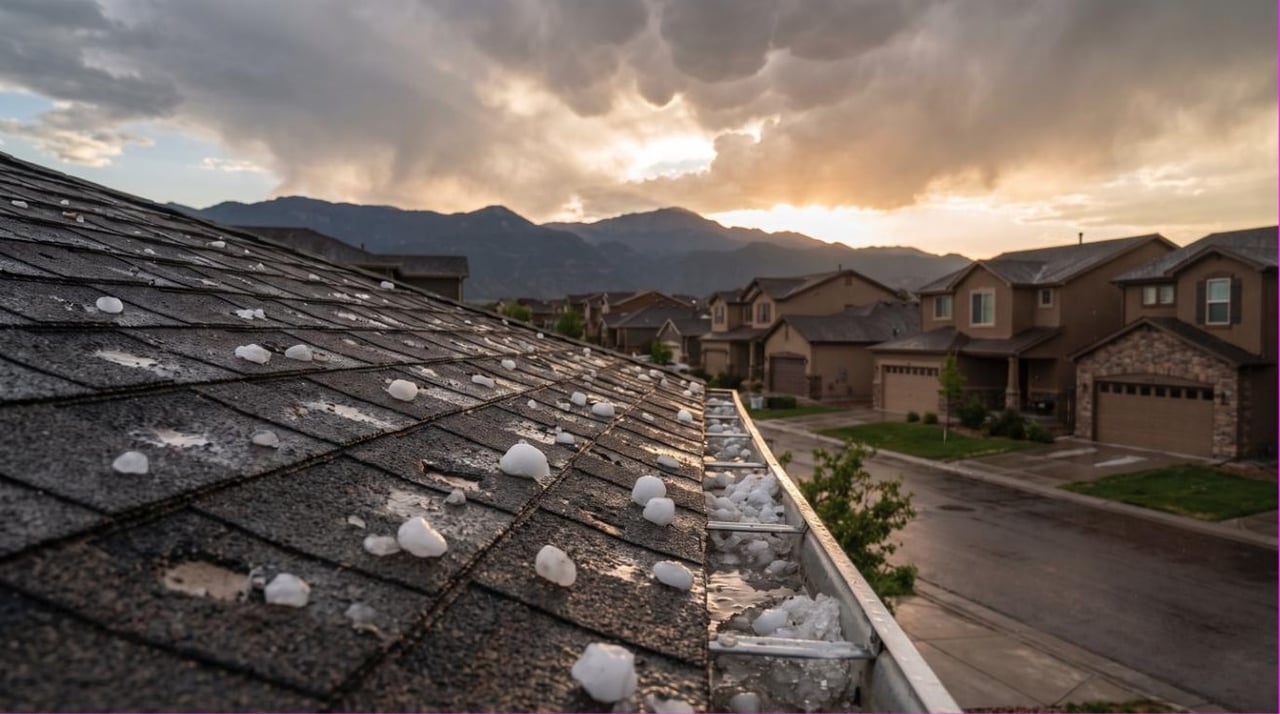
In February the Division of Insurance released the study that settles the argument, drawing on 20 carriers representing about 80% of Colorado market premium across 11 counties. Hail accounts for 26% to 54% of the annual premium depending on county, wildfire for 0.9% to 24.6%. Hail is the largest single cost driver in the state (Colorado Division of Insurance, February 11, 2026).
That surprises people. Wildfire gets the news coverage, so buyers assume fire risk is what they are paying for. Here it is mostly ice.
For El Paso County, KOAA reported hail at 52.5% of premium and wildfire at about 6%, citing that state report (KOAA, February 16, 2026). One caveat. That county row appears in KOAA's coverage, not the Division's own release, so read it as a news outlet's reading of state data.
The state also priced the fix. A hail-resistant roof would save $82 to $387 a year by county (Colorado Division of Insurance, February 11, 2026). CPR reported about $388 for El Paso County (CPR News, February 11, 2026), a dollar above the top of the state's own range. Modeled averages, not a price list.
What hail has actually cost here
This is not theoretical. On July 28, 2016, one storm produced $352.8 million in insured losses and 84,500 claims here: 51,300 auto claims worth $164.6 million, 33,200 property claims worth $188.2 million (Rocky Mountain Insurance Information Association, August 2016). It is still the city's second costliest catastrophe, behind the Waldo Canyon Fire at $470 million. The June 12 and 13, 2018 storm hit El Paso County two years later, Fountain worst, hail to three inches: about $169 million, at least 26,000 claims (RMIIA via KKTV, June 13, 2018).
Geography is the reason. The Front Range sits in "Hail Alley," which gets the highest frequency of large hail in North America, and Colorado averages three to four catastrophic hailstorms a year, meaning $25 million or more in insured damage each (RMIIA). Statewide totals are messy. The Colorado Sun reported more than $5 billion in insured hail damage over the previous decade (The Colorado Sun, January 19, 2025), while RMIIA's own page still says "more than $3 billion." Use the larger figure as a floor.
The roof clause that decides what you collect
This matters more than the premium. Replacement cost pays to put the roof back. Actual cash value pays that minus depreciation for the roof's age.
$15,000 roof loss | Replacement cost | Actual cash value |
|---|---|---|
Depreciation applied | None | $10,000 |
Deductible | $1,000 | $1,000 |
What you receive | $14,000 | $4,000 |
Source: National Association of Insurance Commissioners, July 22, 2021.
Same loss. Same deductible. A $10,000 difference in your bank account.
These provisions are live here right now. Michael Stoycheff is a public adjuster on the board of the Rocky Mountain Association of Public Insurance Adjusters. He told CBS Colorado that homeowners often learn only after a storm that they hold an "ACV (actual cash value) only policy that's only going to pay them maybe 50% of the replacement cost" of a metal roof. Others find "a cosmetic exclusion that doesn't cover their metal roof" (CBS Colorado, June 3, 2026). Cosmetic exclusion means dents that do not leak may not be covered.
Nationally, the same shift. Verisk's vice president of business intelligence, Susan Fleming, described "increased usage across the board of those ACV-only loss provisions," and said the wind and hail deductible is now "consistently, almost always utilized" (Verisk Quarterly Property Report, Q1 2026, via Insurance Journal, July 2026). That report found roof replacement costs up 33% and repair up 25%, while US hail claims fell 23.6% year over year. Verisk attributes the drop to policy language discouraging filing, not less damage. Read that twice. Claims are down because collecting got harder.
Two more things. Roofs over 20 years old generally require an inspection, and older ones may be limited to actual cash value or declined outright (Insurance Information Institute). And Colorado policies increasingly carry a separate wind and hail deductible, which may be a percentage of dwelling coverage rather than a flat dollar figure. Read the declarations page and confirm what dollar amount that produces.
What the law gives you, and what it does not
A disclosure law took effect four weeks ago and it is easy to misread. Under HB25-1182, an insurer using a wildfire risk model must send annual written notice of your wildfire risk score, explain its possible range, disclose mitigation discounts, and publish an appeal process. You may appeal to the insurer, which must acknowledge within 10 calendar days and decide within 30, with Commissioner review if denied (HB25-1182, effective July 1, 2026).
That is wildfire only. No hail risk score disclosure exists and no hail appeal right, a real gap given that hail is the larger share of the premium here.
Worth stating plainly, since plenty of sites claim otherwise: no Colorado law now in effect caps, restricts or standardizes hail or wind deductibles, and no Division of Insurance regulation does either. SB26-049, which would have created tax-advantaged catastrophe savings accounts for hail deductibles, died in Senate Appropriations (Colorado General Assembly, May 14, 2026).
One piece almost nobody writes about. The Colorado FAIR Plan, created by HB23-1288, began writing residential policies April 10, 2025. It is the insurer of last resort, a nonprofit funded by carrier assessments rather than public money, and you must show three companies declined you. Those grounds explicitly include hail risk and claims history, not just wildfire. It covers actual cash value, not the cost to rebuild (Colorado FAIR Plan). Land there with an aging roof and you are exposed twice.
The grant program that starts next year
This is the most actionable thing here, and it takes effect in two weeks. SB26-155 created the Strengthen Colorado Homes Enterprise inside the Division of Insurance to fund grants for impact-resistant roof systems (SB26-155, signed June 4, 2026, effective August 12, 2026). It is funded by an annual fee on insurers of 0.5% of prior-year Colorado multiperil homeowners premium, starting 2027, capped so revenue stays under $100 million over five years. Insurers may not surcharge it to policyholders.
Commissioner Michael Conway says grants will run $7,500 to $10,000 per homeowner, with the board seated by the end of 2026 and grants starting no earlier than 2027 (The Colorado Sun, July 18, 2026). The law directs at least 85% of fee revenue into retrofit grants per the legislature's bill summary, though some accounts of the enrolled bill put the floor at 90%. Governor Polis says the effort would save Coloradans $800 a year, a political projection rather than a measured result.
Planning a roof in the next 18 months? That timing deserves thought. The upgrade to an impact-resistant system runs roughly $3,000 to $5,000 extra on a 2,000 square foot home, per industry estimates (The Colorado Sun, July 18, 2026), and Class 4 is the top rating under the UL 2218 impact standard (RMIIA). Discounts vary by carrier. You will see 15% to 30% quoted online, but I could only trace that to roofing-contractor marketing pages, not a regulator or carrier filing. Confirm your carrier's credit first.
Check your dwelling limit too. After the Marshall Fire, 74% of affected homeowners proved underinsured, 36% of those severely, meaning coverage below 75% of replacement cost (University of Colorado Boulder, January 2025; via CSU REDI, August 2025). A stale limit does not care which peril finds you.
What to ask before you are under contract
- Quote the specific address, before you are under contract. Not a state average. Two houses on one street can quote very differently.
- Ask whether the roof settles at replacement cost or actual cash value, in writing. The $10,000 question above.
- Ask whether there is a separate wind and hail deductible, and what dollar figure it produces. If it is a percentage, do the multiplication with your agent.
- Ask the roof's age and whether the carrier requires an inspection. Past 20 years, ask about eligibility directly.
- Ask whether prior hail claims on the property follow it. Claims history attaches to the address and affects rate and eligibility both.
- If the seller replaced the roof, ask for the permit and whether it is Class 4. "New roof" in a listing is not the same as permitted, impact-rated work.
Confirm all of it with a licensed insurance professional and with the carrier. I am a REALTOR, not an agent, and the declarations page is the only document that governs what you are owed.
Common questions
How much is homeowners insurance in Colorado Springs?
Mid-2026 published averages run $4,343 to $5,804 depending on source and coverage (MoneyGeek, May 21, 2026; Insurify, July 15, 2026; Insure.com, May 27, 2026). Insure.com names State Farm cheapest at $2,585. It is a shopping range, not a price.
Why is my quote so much higher than at my last house?
Two things stack. Colorado premiums rose 100.8% since 2019, the steepest in the country (LendingTree via The Colorado Sun, July 11, 2026), and roughly half of an El Paso County premium buys hail protection (KOAA citing the Division of Insurance, February 16, 2026). From a state without hail, you are seeing that share for the first time.
Can I appeal a hail risk score like a wildfire score?
No. HB25-1182 created notice and appeal rights for wildfire risk scores only, effective July 1, 2026. Nothing equivalent exists for hail.
Where this leaves you
Quote it early. A $1,400 swing in premium moves a payment about as much as a quarter point of rate does, and it is far easier to shop. For the wider cost picture I broke down what income it takes to live here and an honest guide to moving to Colorado Springs. On the weather, what it is really like here. On timing, whether this is a good time to buy.
Leah Behr is a licensed REALTOR® with the Behr & Behr Team in Colorado Springs. She has lived here since 2009, through the 2016 and 2018 hailstorms, and walks buyers through an insurance quote before they go under contract. Policy questions belong with a licensed carrier or broker. Get in touch with our team.
Behr & Behr Team is committed to Equal Housing Opportunity. All information is deemed reliable but not guaranteed and should be independently verified.